Aesthetics and the Planetary Turn

From: Handbook of Latin American Environmental Aesthetics, ed. Jens Andermann, Gabriel Giorgi, and Victoria Saramago (Berlin, New York: De Gruyter, 2023), “Introduction”

(…) What the contributions to this volume are after are the multiple reconfigurations of bodies and environments within the geology of late capitalism, the moment when, as Déborah Danowski and Eduardo Viveiros de Castro put it, the “transformation of humans into a geological force, that is, into an ‘objective’ phenomenon or ‘natural’ object, is paid back with the intrusion of Gaia in the human world, giving the Earth System the menacing form of a historical subject, a political agent, a moral person.” Such an entanglement of agencies, they conclude, also entails an “inversion of the relationship between figure and ground, the ambiented becomes the ambient […] and the converse is equally the case” (Danowski and Viveiros de Castro 2017, 14).

What we call environmental aesthetics is lodged in the very moment of inversion called out by Danowski and Viveiros de Castro. Aesthetics is a concept that, at least since its re-introduction into modern critical thought by Alexander Gottlieb Baumgarten in the early eighteenth century, has been deployed as both referring to the sensory and imaginative experience of beauty—and thus also to a mode of accessing truth by way of “sensible discourse” rather than logical reasoning, in Baumgarten’s (1954, 6-10) expression—and as the “science of perception” that asks, as Kant would posit, for the general principles underwriting individual aesthetic judgements. The artwork, as it arranges the sensory in ways that strive towards perfection, thus making it accessible to “taste” as an experience of truth that is analog to yet also distinct from, critical reason, is therefore also invested with an implicit epistemic power that the discipline of aesthetics is entrusted with drawing out and making explicit. (…) Going beyond the contemplation of nature in this tradition as a vehicle for the experience of beauty or the emergence of the sublime, the “environmental” in environmental aesthetics also complicates the idealistic baggage the term aesthetics carries with it.

“Environment” is a notion first used in systematic fashion by the nineteenth-century positivist thought of Auguste Comte and Herbert Spencer, who used it to describe “the circumstances of an organism” (Bonneuil and Fressoz 2016, 173)—before, it had been deployed colloquially to refer to the surroundings of towns and cities, i.e. “the countryside.” Ernst Haeckel, in 1867, coined the notion of “ecology” highlighting the symbiotic effects among living organisms and between those and their physical conditions of existence, in response to Darwin’s notion of the struggle for survival; in early twentieth-century biology, Johann Jakob von Uexküll further developed the biosemiotic dimension of the concept as an at once perceptive and life-sustaining entanglement between organisms and their surroundings. Yet, as David Arnold (1996) has shown, environmental determinism had already informed Western thought long before it became a systematic concept in its own right, underwriting and justifying imperial expansion and the enslavement and forced migration of non-Europeans, including in Montesquieu’s and Buckle’s climatology or the biological racism of Gobineau and Malthus.[1] Nonetheless, and despite having been trained by late twentieth-century strands of thought such as poststructuralism, deconstruction, feminism and performance theory to be suspicious of all appeals to “nature” as the ultimate cause of, and normative benchmark for, human action, the surge of the planetary as encountered in Williams’s film (and in myriad forms of environmental emergency) also forces us today to double down on this critique of “nature” and rethink the agentiality of the nonhuman in different ways. For if “Gaia,” the earth system, or the “more-than-human” are no longer just objects of perception and of sensory pleasure, as Danowski and Viveiros de Castro contend, but have shown themselves to be agential, and thus also perceptive, in their own right, do we not need now to rethink the aesthetic itself as the fragile and precarious field of encounter, or even of “sympoiesis” (in Donna Haraway’s expression), between diverse existents engaged in imagining and in crafting a shared “becoming-with” (Haraway 2016, 4; 58)?

The essays assembled in this volume take stock of the lines of critical revision and of the terms and concepts that have emerged in recent years in response to this question. Two principal tasks, in fact, seem to articulate the main coordinates at work in environmental aesthetics: on the one hand, to reconfigure the sensorium that allows us to imagine, perceive, narrate and think the passage from the global to the planetary; on the other, to re-conceptualize aesthetics—in a tradition that also involves the avant-garde as well as posthuman thinking—in a way that allows us to disrupt received notions of aesthetics and make room to other arrangements of the sensible that register the agency of the non-human and the non-living. Stengers’s “intrusion of Gaia” and the now-ubiquitous notion of the Anthropocene—referring to the “major and still-growing impacts of human activity on earth and atmosphere” (Crutzen & Stoermer 2000, 17) to the point of becoming the dominant geological force of our age—as well as rival ones such as Capitalocene, Plantationocene, Gynocene or Chthulucene (all of which attempt to call into question the residual humanism of Anthropocene theory) are challenging the very foundations of modern Western aesthetics, politics and theory as premised on the ontological distinction between humanity (and hence “culture”), on the one hand, and of nonhuman “nature”, on the other (Latour 1993, 10; 32). Whichever position we choose to take with regard to its key concept, “the Anthropocene debate”—as postcolonial historian Dipesh Chakrabarty (2021, 155) contends—“thus entails a constant conceptual traffic between earth history and world history,” and to help enable such traffic by way of new concepts and paradigms at a time of advancing deterioration of the biosphere and unprecedented mass extinction at a planetary scale is the urgent task that has been set for environmental aesthetics.

Such an endeavor must of necessity be at once critical and speculative. In the former sense, it has to revisit the archive of modern arts and literature as well as that of the responses aesthetic theory has crafted from these, in order to understand their impact on, and even complicity with, the establishment and policing of the modern nature-culture boundary. In a compelling, hard-hitting book, Indian novelist and literary scholar Amitav Ghosh suggests that canonical forms of Western modernism such as the realist novel and abstract art have been of fundamental importance for establishing the primacy of human “current affairs” over their cataclysmic, short as well as long-term, entanglements with cosmic forces. The exceptional, the wondrous, “the unheard-of and the unlikely [that] fiction delighted in” prior to the emergence of realism, he suggests, have been banished in modernity to the B-genres of sci-fi and fantasy, with abstraction upping the stakes even further in eliminating reference altogether and placing “human consciousness, agency and identity […] at the center of every kind of aesthetic enterprise” (Ghosh 2016, 16; 120). Yet ecocritical approaches, particularly in the realm of literature, have also sought to re-appraise the areas and forms of dissidence that have always accompanied these hegemonic frameworks, attempting to track—in Richard Kerridge’s early description of the field—“environmental ideas and representations [and] to evaluate texts and ideas in terms of their coherence and usefulness as responses to environmental crisis” (Kerridge 1998, 5).

However, in addition to the important and necessary project of re-assessing the androcentric founding premises of modern aesthetics, and thus also of the histories of literature, art and film that underwrite the critical frameworks of our academic disciplines, environmental aesthetics as the two-way traffic between artistic production and the critical thought that draws out its interfaces with wider, socio-cultural as well as earth-systemic developments, is also in the business of imagining things differently—of mobilizing the powers of speculation to imagine but also create other ways of inhabiting the planet. The arts, as environmental humanities scholar Carolyn Merchant contends, “are an essential part of creating the large-scale public awareness and understanding of climate change that can bring about policy change,” in challenging “the standard human/environment narrative, in which humans are both privileged over other species and separate from nature. Indeed, artists can change the way we think about the meaning of progress” (Merchant 2020, 46). An aesthetics of and in the Anthropocene, as literary critic David Farrier suggests referring to a line from Irish poet Seamus Heany, must open up and inhabit “the rift between what is going to happen and whatever we wish to happen […] In doing so, it can point us to a careful retying of the knots that bind us together, in deep time, with the fate of the Earth” (Farrier 2019, 128). Indeed, if the speculative efforts of the epistêmê aisthetikê—the “science of what is sensed and imagined,” in Baumgarten’s (1954, 86-87) definition—will now have to be re-oriented towards “reading for the planet,” in energy humanities scholar Jennifer Wenzel’s (2020, 1) powerful expression, such “world-imagining” through and with art might also require us to expand our very notion of the artistic beyond conventional genres and expressive languages and toward the “sites of expanded creativity” that are in the business of “the experimental practice of world-making,” in art theorist T. J. Demos’s words. The environmental aesthetics, Demos suggests, concern themselves with the expanded field of “creative ecologies—practices that make new sensible materializations and connections (aesthetic, practical, jurisgenerative) between otherwise discrete realms of experience and knowledge, and that cultivate worlds to come” (Demos 2020, 18). On this note, literary scholar Florencia Garramuño has put forward the notion of “unspecificity” as a way of thinking about how contemporary aesthetic production, in novel and heterogeneous alliances with other realms of social practice that modernist aesthetics had kept separate from the domain of art as distinctive and “autonomous” from these, imagines and thus calls into being, “worlds-in-common”: unspecific aesthetics, for her, is the elaboration of “a language of commonalitythat encourages the invention of diverse modes of disbelonging” as the shared condition of existents in thrall to planetary crisis (Garramuño 2015, 26). Anthropologists Marisol de la Cadena and Mario Blaser have suggested the notion of “the uncommons” to account for this paradoxical togetherness of diverse agents brought about by their shared exposure to climate breakdown and mass extinction, an allyship that necessarily relies on the creative faculty of humans and nonhumans alike to be willed into being. The uncommons, then, is “the heterogeneous grounds where negotiations take place toward a commons that would be a continuous achievement, an event whose vocation is not to be final because it remembers that the uncommons is its constant starting point” (Blaser and De la Cadena 2017, 19). In different ways, these voices resonate and dialogue with a persistent theme in the twentieth-century Latin American intellectual tradition.


[1] See also Bonneuil and Fressoz’s chapter on the “Polemocene” for a more nuanced history of proto-ecological ideas in the West beyond biological and climate determinism (Bonneuil and Fressoz 2016, 253 ff).

For more details on the Handbook, click here.

To visit the Table of Contents, click here.

To buy or access through a library, click here.

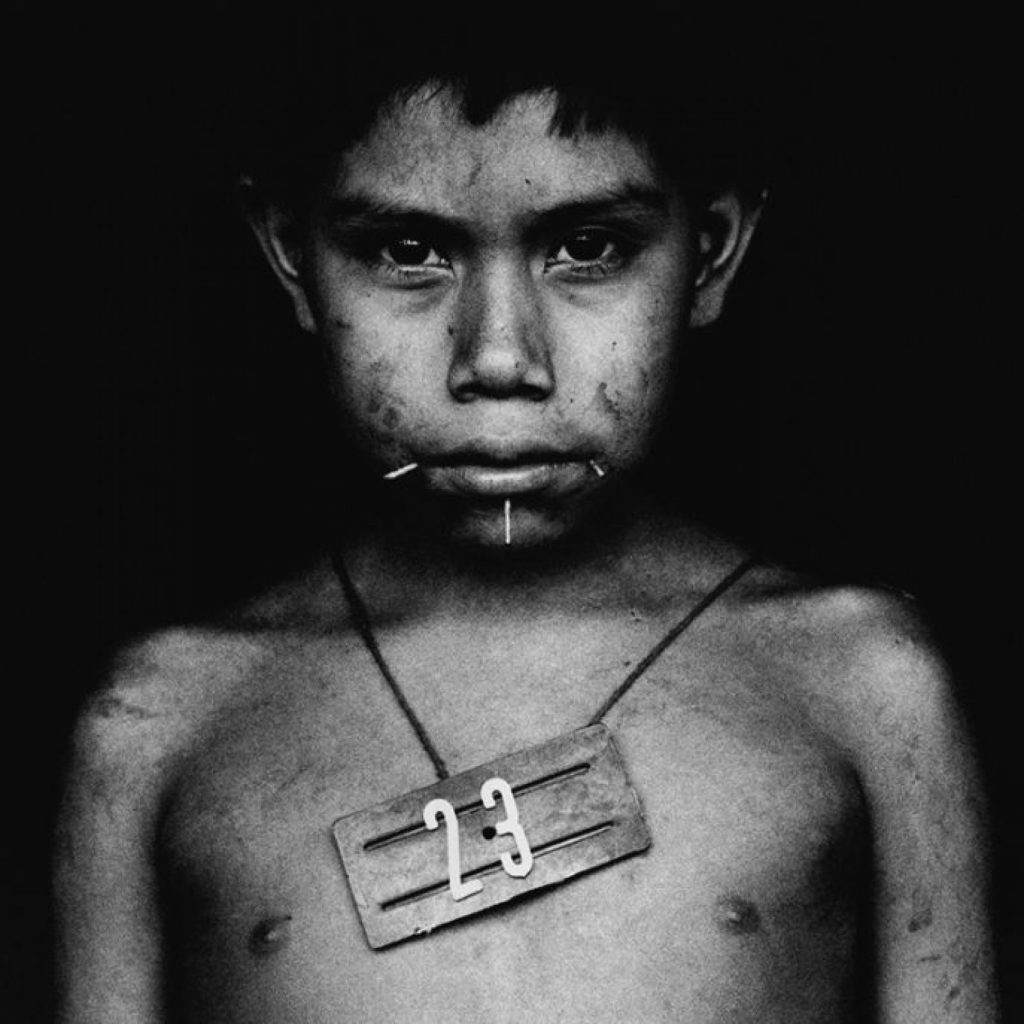
La noche de los Xawarari: notas sobre epidemiología amazónica

Claudia Andujar, de la serie “Marcados” (1980-1984)

Acaba de salir mi artículo integrante del dossier “Lecturas de/sobre pandemia: anticipación y anacronía”, coordinado por Alicia Vaggione y Paola Cortés Rocca (Revista Heterotopías 4:7, 2021).

Resumen

La pandemia de Covid-19, en particular desde el auge de la llamada variante Manaos o P1, ha tenido en la región amazónica uno de sus epicentros más recientes, con consecuencias devastadoras para las comunidades indígenas y campesinas de la región quienes frecuentemente carecen de acceso a los más elementales servicios de salud. El impacto agravado del coronavirus sobre los pueblos amazónicos, por otra parte, no hace más que reactualizar e intensificar un ciclo muchas veces ininterrumpido desde el primer contactocon la sociedad blanca, como revelan con elocuencia los retratos de miembros del pueblo Yanomami tomados por Claudia Andujar a principios de los ochenta en el marco de una campaña de vacunación contra las epidemias causadas por la apertura de la Transamazónica y el boom aurífero en la región. En este ensayo, analizo el libro-testimonio La caída del cielo, co-escrito por el chamán y activista Davi Kopenawa y el antropólogo Bruce Albert, como el esbozo de una epidemiología amazónica. En contraste con —aunque no necesariamente en contra de—una biopolítica humanitaria que (como la serie fotográfica de Andujar) busca inmunizar a cuerpos individuales en función de blindar a la población de los efectos de la máquina necropolítica extractivista, esta epidemiología piensa a las enfermedades en clave cosmo-política, como un desafío a la extensa red de transculturaciones narrativasentre existentes que forman el mundo-bosque, y que el propio texto de Kopenawa y Albert procura rehacer desde y sobre la catástrofe.

Para texto completo, hacer clic aquí.

Abstract

The Amazon has been a recent epicenter of the Covid-19 pandemic, particularly since the rise of the so-called Manaus or P1variant, with devastating consequences for Indigenous and peasant communities in the region who frequently lack access to the most basic health services. The aggravated impact of the coronavirus on the Amazonian peoples, on the other hand, does nothing more than update and intensify a cycle many times uninterrupted from the first contact with white society, as the portraits of members of the Yanomami people taken by Claudia Andujar in the early eighties in the contextof a vaccination campaign against the epidemics caused by the opening of the Transamazónica and the goldrushin the regionso eloquently show.In this essay, I analyzeThe Falling Sky, a book co-written by the shaman and activist Davi Kopenawa and the anthropologist Bruce Albert, as outlining an Amazonian epidemiology. In contrast with—though not necessarily against—a humanitarian biopolitics that (like Andujar’s photographic series) seeks to immunize individual bodies in order to shield the population from the effects of the extractive necropolitical machine, this epidemiology thinks about diseases in a cosmo-political key, as a challenge to the extensive network of narrative transculturations between existents that make up the forest, and that the text of Kopenawa and Albert tries to remake in the face of catastrophe.

For full text, please click here.

El giro fascista: cinco hipótesis

Texto completo en el Blog del Journal of Latin American Cultural Studies

integralismo

(Cartel de Ação Integralista Brasileira, años 30)

Como la explosión de un absceso purulento, la victoria con más del 55 % en las elecciones presidenciales brasileñas de un candidato abiertamente racista, misógino y homofóbico, defensor entusiasta de dictaduras y de la tortura de opositores, partidario de soluciones eugenésicas para indígenas y afrobrasileños a quienes ha tildado de hediondos, ignorantes y criminales –cuando no directamente de cualquier disidencia política, religiosa o cultural– produce al menos un efecto saludable de sinceramiento. Porque no solo, como era de esperar, no perdieron tiempo en celebrar la llegada a sus filas del Führer tropical los Trump, Salvini, Le Pen, Orban — la lista podría alargarse infinitamente. También las educadas y cosmopolitas “derechas democráticas” de nuestras republiquetas vecinas, cuyas loas cantaba hace apenas unos años el editorialismo de cuello blanco, se aprestaron por hacer constar, por si quedaba alguna duda, de que también ellas, por supuesto, habían militado desde siempre en la falange donde reviste el reservista vencedor. Era uno más del palo el verdeamarillento, sacaban pecho los Piñera, los Macri, los Cartes; verdadero visionario –se emocionaba el canciller argentino Faurie ya tras la primera vuelta– con el ojo puesto en el futuro y no en el pasado. Pero si era tanto el apuro de los hasta anoche vestales del republicanismo pampeano por probarse la camisa marrón antes de que se las arrebate el primer hijo de carnicero, ¿no se cae por su propio peso la teoría de los dos demonios, previsiblemente desempolvada por personajes nefastos como el ex-presidente FHC? En declaraciones a la Folha el ex-sociólogo hacía saber que, contrario a lo que las incontinencias del personaje parecieran indicar, los brasileños no habían depositado su fe en un nazi confeso, ni siquiera un fascista, no: apenas un “autoritario”, esa mágica palabra-coartada que ya le había rendido tan buenos servicios, a FHC y sus socios, en los viejos buenos tiempos de la “transición democrática”. Y cuyo diagnóstico, como seguramente no tardarán en rematar los Vargas Llosa, los Castañeda y otras viudas del neoliberalismo noventista, ¿no había sido comprobado, precisamente, por la reciente elección mexicana de otro demagogo carismático, no importa que de prédica diametralmente opuesta a la del capitán carioca? ¿La culpa no será, por tanto, y como era de esperar, del infame populismo, ese que ahora se lame sus heridas cuando había desatado él mismo la bestia que ahora lo devora? ¡Ya está en los quioscos! — solo que, por más que la repitan, esa tierna fábula liberal de aprendices de brujos no deja de chocar con el sencillo hecho de que los votantes del ex-militar y los del ex-alcalde de la capital azteca no son en su inmensa mayoría los mismos, como tampoco lo son los del ex-obrero metalúrgico: si fuera solo por el voto de los favelados, los nordestinos, los sectores de menos recursos –la plebe, en suma– Haddad habría ganado de manera contundente. En cambio, ya lo han dicho voces más calificadas, los problemas empiezan cuando los que ya no quieren pertenecer a ese pueblo populista, esas proverbiales cuarenta millones de ex-pobres, “la nueva clase media de Lula”, se desmarcan de esa alianza con la violencia propia de los conversos. Pero si ése es el eje por el que gira el giro fascista: ¿qué expresa la aceleración vertiginosa de su espiral violenta? ¿Hacia donde apunta su odio?

Leer texto completo en blog del Journal of Latin American Cultural Studies

The end of transition: working notes

I wrote the following notes for the closing round-table of the symposium “Performing Human Rights: Contesting Amnesia and Historical Justice in Latin America and the Middle East”, University of Zurich, June 28-29, 2018. Because of the quite lively discussion these remarks provoked, I share them here as an invitation to think and discuss further. I thank the conference organizers, Liliana Gómez-Popescu and Bettina Dennerlein, for challenging me to return to the question of transitional justice and human rights.

Screenshot 2018-06-30 19.20.12

Anti-PT manifestation, Brazil, 2015 (photo: blog União da Juventude Socialista)

Coined in the legal and political sciences in the 1980s and 1990s, especially in the ambit of international organizations, the concept of transitional justice was tasked with managing governance in contexts of negotiated handovers of state power from “authoritarian” to “democratic” governments, in contexts that ranged from Latin America’s Southern Cone to the end of apartheid in South Africa to the rapidly disintegrating map of post-Soviet Eastern Europe. The very notion of a “return to democracy” frequently associated with discourses of democratic transition also framed the latter as a universal, normative standard that had been interrupted by authoritarian exception. Transitional justice, a label that was quickly being applied to postgraduate programs and government agencies the world over, offered a framework for comparing –that is, for measuring the relative success or failure within the quantifiable parameters of benchmarks, indices and goalposts held dear by governments and international institutions– processes of compartmentalizing the political contingencies of these “transitions” into discrete, and partially autonomous, institutional realms. Transitional justice, in short, ensured the reconfiguration of politics as administration, and it did so, centrally, in parsing out, on the one hand, more or less limited forms of legal prosecution of human rights violations (frequently reparative rather than retaliatory), and on the other hand the opening-up of institutional settings for the productions of testimony, where victims’ memory performances could be played out within “safe spaces”.

Admittedly, I’m offering a schematic, even caricaturesque, summary here of processes which, at a national or even local level always played out in much more complex and contradictory ways — but the point here is, precisely, that transitional justice, as an imaginary gold standard of such diverse processes, openly promoted itself as an enabling fiction, one to which the political itself had to succumb, it was suggested, in order to be able to unleash its potentiality and contingency once again once the “transition process” had been successfully completed.

In Latin America, this notion of transition and the historical narrative of normalcy and aberration it implicitly subscribed to, have been submitted from very early on to a radical critique and counter-narrative that has been associated with the concept of postdictatorship, that is, with the various modes of dictatorial afterlife the idea of transition both obscured and enabled. For what if not dictatorship has been the “transitional” moment that violently separates, in Latin American late modernity, the increasingly radicalized national-popular movements and governments of the 1960s and 1970s from the neoliberal regimes that succeeded, or perhaps rather, were ushered in by, military State terror? Against the origin myth of democratic continuity interrupted by authoritarian exception, tantamount to emptying history of politics, postdictatorship proposed a narrative of catastrophic defeat, of which the discourse of democratic transition was itself symptomatic: transitional justice, as the legal-institutional administration of (neoliberal) governance “after terror” confirmed the successful violent destruction, and inability to suture or reconstruct in the present, of the languages of decolonizing emancipation the dictatorships had violently cut short.

The rise and fall of center-left governments in Latin America after the millennium (the so-called pink tide) can thus also be understood, in retrospect, as a failed attempt to re-introduce the political into the empty time of neoliberal administration, constituted upon the discursive and institutional frameworks of “democratic transition”. Yet what this failure has presently unleashed is a wave of necropolitical vengeance that far exceeds the mere reinstatement of the neoliberal status quo ante. Instead, I suggest, the open instrumentalization of lawfare for political ends and the cynical tweaking or outright violation of constitutional norms (as in Honduras, Paraguay or Brazil) on behalf of a resurgent right mark the true “end of transition”, in the sense not just of the completion of a cycle but also, and foremost, as revealing the political and historical ends the former was always already transitioning towards.

The end of transition, if indeed we were to think of the present moment in Latin America under this heading, would then imply a range of challenges to critical thinking and the politics of resistance alike. I want to sketch out just two: firstly, beyond the critique of the political and legal underwritings of transitional governance the notion of postdictatorship has allowed us to perform, we would urgently need to expand our frameworks today towards a more systematic, longue durée point of view that would allow us to encompass (as fundamental) the economic dimension of “transition”. What “transition” will have turned out to have transitioned towards, what it literally prepared the ground for, would then take shape as a violent, even genocidal, neo-extractive cycle currently rolling across the Global South and beyond, and of which the racist, misogynistic, and homo/transphobic necropolitics of the dominant neofascism in the Americas are part and parcel. What we need is a reframing and retooling of our critical instruments in order to be able to name the way in which dictatorial terror and neoliberal accumulation-through-dispossession alike participate of an extractivist matrix that takes bodily and earthly surfaces –the living and the material– as “overburden” and as targets of its extractive bio- and necropolitics. It is no accident, after all, that indigenous persons and women have presently emerged as the principal agents of resistance, and as the main targets of fascist violence, as the assassinations of Heather Heyer, Bertha Cáceres and Marielle Franco in the United States, Guatemala and Brazil, or the illegal imprisonment, torture and assassination of Kolla and Mapuche leaders in Argentina and Chile show all too eloquently.

Secondly, perhaps the field of memory studies as presently configured has neglected for too long, and to its own peril, the way in which the neofascist resurgence has itself been underwritten by “memory performances”, from the various kinds of ritual homage paid to icons of white suprematism and slavery in the U.S. South to the mobilizations of perpetrators’ relatives and their political and mediatic allies in Brazil, Argentina and Chile, which once more openly defend military tortures and assassinations perpetrated, the story now goes, in the sacrificial defense of the nation against leftist “corruption”. In what ways, we need to ask, have the “subjective” and “performative turns” in memory studies, as developed within ethical imperatives of empathizing with the experiences and demands of victims, been neglecting these memory performances of the enemy? Has the privileging of memory over history, however important in contexts of recovering experiences of suffering and resistance, suddenly left us exposed against the fascist rewriting/reperforming of the past? The challenge for the Left today, it seems to me, is then about moving beyond extant critiques of the transitional consensus as outlined above, and towards a more comprehensive engagement with what transition was actually heading towards.