
From: Handbook of Latin American Environmental Aesthetics, ed. Jens Andermann, Gabriel Giorgi, and Victoria Saramago (Berlin, New York: De Gruyter, 2023), “Introduction”

(…) What the contributions to this volume are after are the multiple reconfigurations of bodies and environments within the geology of late capitalism, the moment when, as Déborah Danowski and Eduardo Viveiros de Castro put it, the “transformation of humans into a geological force, that is, into an ‘objective’ phenomenon or ‘natural’ object, is paid back with the intrusion of Gaia in the human world, giving the Earth System the menacing form of a historical subject, a political agent, a moral person.” Such an entanglement of agencies, they conclude, also entails an “inversion of the relationship between figure and ground, the ambiented becomes the ambient […] and the converse is equally the case” (Danowski and Viveiros de Castro 2017, 14).
What we call environmental aesthetics is lodged in the very moment of inversion called out by Danowski and Viveiros de Castro. Aesthetics is a concept that, at least since its re-introduction into modern critical thought by Alexander Gottlieb Baumgarten in the early eighteenth century, has been deployed as both referring to the sensory and imaginative experience of beauty—and thus also to a mode of accessing truth by way of “sensible discourse” rather than logical reasoning, in Baumgarten’s (1954, 6-10) expression—and as the “science of perception” that asks, as Kant would posit, for the general principles underwriting individual aesthetic judgements. The artwork, as it arranges the sensory in ways that strive towards perfection, thus making it accessible to “taste” as an experience of truth that is analog to yet also distinct from, critical reason, is therefore also invested with an implicit epistemic power that the discipline of aesthetics is entrusted with drawing out and making explicit. (…) Going beyond the contemplation of nature in this tradition as a vehicle for the experience of beauty or the emergence of the sublime, the “environmental” in environmental aesthetics also complicates the idealistic baggage the term aesthetics carries with it.
“Environment” is a notion first used in systematic fashion by the nineteenth-century positivist thought of Auguste Comte and Herbert Spencer, who used it to describe “the circumstances of an organism” (Bonneuil and Fressoz 2016, 173)—before, it had been deployed colloquially to refer to the surroundings of towns and cities, i.e. “the countryside.” Ernst Haeckel, in 1867, coined the notion of “ecology” highlighting the symbiotic effects among living organisms and between those and their physical conditions of existence, in response to Darwin’s notion of the struggle for survival; in early twentieth-century biology, Johann Jakob von Uexküll further developed the biosemiotic dimension of the concept as an at once perceptive and life-sustaining entanglement between organisms and their surroundings. Yet, as David Arnold (1996) has shown, environmental determinism had already informed Western thought long before it became a systematic concept in its own right, underwriting and justifying imperial expansion and the enslavement and forced migration of non-Europeans, including in Montesquieu’s and Buckle’s climatology or the biological racism of Gobineau and Malthus.[1] Nonetheless, and despite having been trained by late twentieth-century strands of thought such as poststructuralism, deconstruction, feminism and performance theory to be suspicious of all appeals to “nature” as the ultimate cause of, and normative benchmark for, human action, the surge of the planetary as encountered in Williams’s film (and in myriad forms of environmental emergency) also forces us today to double down on this critique of “nature” and rethink the agentiality of the nonhuman in different ways. For if “Gaia,” the earth system, or the “more-than-human” are no longer just objects of perception and of sensory pleasure, as Danowski and Viveiros de Castro contend, but have shown themselves to be agential, and thus also perceptive, in their own right, do we not need now to rethink the aesthetic itself as the fragile and precarious field of encounter, or even of “sympoiesis” (in Donna Haraway’s expression), between diverse existents engaged in imagining and in crafting a shared “becoming-with” (Haraway 2016, 4; 58)?
The essays assembled in this volume take stock of the lines of critical revision and of the terms and concepts that have emerged in recent years in response to this question. Two principal tasks, in fact, seem to articulate the main coordinates at work in environmental aesthetics: on the one hand, to reconfigure the sensorium that allows us to imagine, perceive, narrate and think the passage from the global to the planetary; on the other, to re-conceptualize aesthetics—in a tradition that also involves the avant-garde as well as posthuman thinking—in a way that allows us to disrupt received notions of aesthetics and make room to other arrangements of the sensible that register the agency of the non-human and the non-living. Stengers’s “intrusion of Gaia” and the now-ubiquitous notion of the Anthropocene—referring to the “major and still-growing impacts of human activity on earth and atmosphere” (Crutzen & Stoermer 2000, 17) to the point of becoming the dominant geological force of our age—as well as rival ones such as Capitalocene, Plantationocene, Gynocene or Chthulucene (all of which attempt to call into question the residual humanism of Anthropocene theory) are challenging the very foundations of modern Western aesthetics, politics and theory as premised on the ontological distinction between humanity (and hence “culture”), on the one hand, and of nonhuman “nature”, on the other (Latour 1993, 10; 32). Whichever position we choose to take with regard to its key concept, “the Anthropocene debate”—as postcolonial historian Dipesh Chakrabarty (2021, 155) contends—“thus entails a constant conceptual traffic between earth history and world history,” and to help enable such traffic by way of new concepts and paradigms at a time of advancing deterioration of the biosphere and unprecedented mass extinction at a planetary scale is the urgent task that has been set for environmental aesthetics.
Such an endeavor must of necessity be at once critical and speculative. In the former sense, it has to revisit the archive of modern arts and literature as well as that of the responses aesthetic theory has crafted from these, in order to understand their impact on, and even complicity with, the establishment and policing of the modern nature-culture boundary. In a compelling, hard-hitting book, Indian novelist and literary scholar Amitav Ghosh suggests that canonical forms of Western modernism such as the realist novel and abstract art have been of fundamental importance for establishing the primacy of human “current affairs” over their cataclysmic, short as well as long-term, entanglements with cosmic forces. The exceptional, the wondrous, “the unheard-of and the unlikely [that] fiction delighted in” prior to the emergence of realism, he suggests, have been banished in modernity to the B-genres of sci-fi and fantasy, with abstraction upping the stakes even further in eliminating reference altogether and placing “human consciousness, agency and identity […] at the center of every kind of aesthetic enterprise” (Ghosh 2016, 16; 120). Yet ecocritical approaches, particularly in the realm of literature, have also sought to re-appraise the areas and forms of dissidence that have always accompanied these hegemonic frameworks, attempting to track—in Richard Kerridge’s early description of the field—“environmental ideas and representations [and] to evaluate texts and ideas in terms of their coherence and usefulness as responses to environmental crisis” (Kerridge 1998, 5).
However, in addition to the important and necessary project of re-assessing the androcentric founding premises of modern aesthetics, and thus also of the histories of literature, art and film that underwrite the critical frameworks of our academic disciplines, environmental aesthetics as the two-way traffic between artistic production and the critical thought that draws out its interfaces with wider, socio-cultural as well as earth-systemic developments, is also in the business of imagining things differently—of mobilizing the powers of speculation to imagine but also create other ways of inhabiting the planet. The arts, as environmental humanities scholar Carolyn Merchant contends, “are an essential part of creating the large-scale public awareness and understanding of climate change that can bring about policy change,” in challenging “the standard human/environment narrative, in which humans are both privileged over other species and separate from nature. Indeed, artists can change the way we think about the meaning of progress” (Merchant 2020, 46). An aesthetics of and in the Anthropocene, as literary critic David Farrier suggests referring to a line from Irish poet Seamus Heany, must open up and inhabit “the rift between what is going to happen and whatever we wish to happen […] In doing so, it can point us to a careful retying of the knots that bind us together, in deep time, with the fate of the Earth” (Farrier 2019, 128). Indeed, if the speculative efforts of the epistêmê aisthetikê—the “science of what is sensed and imagined,” in Baumgarten’s (1954, 86-87) definition—will now have to be re-oriented towards “reading for the planet,” in energy humanities scholar Jennifer Wenzel’s (2020, 1) powerful expression, such “world-imagining” through and with art might also require us to expand our very notion of the artistic beyond conventional genres and expressive languages and toward the “sites of expanded creativity” that are in the business of “the experimental practice of world-making,” in art theorist T. J. Demos’s words. The environmental aesthetics, Demos suggests, concern themselves with the expanded field of “creative ecologies—practices that make new sensible materializations and connections (aesthetic, practical, jurisgenerative) between otherwise discrete realms of experience and knowledge, and that cultivate worlds to come” (Demos 2020, 18). On this note, literary scholar Florencia Garramuño has put forward the notion of “unspecificity” as a way of thinking about how contemporary aesthetic production, in novel and heterogeneous alliances with other realms of social practice that modernist aesthetics had kept separate from the domain of art as distinctive and “autonomous” from these, imagines and thus calls into being, “worlds-in-common”: unspecific aesthetics, for her, is the elaboration of “a language of commonalitythat encourages the invention of diverse modes of disbelonging” as the shared condition of existents in thrall to planetary crisis (Garramuño 2015, 26). Anthropologists Marisol de la Cadena and Mario Blaser have suggested the notion of “the uncommons” to account for this paradoxical togetherness of diverse agents brought about by their shared exposure to climate breakdown and mass extinction, an allyship that necessarily relies on the creative faculty of humans and nonhumans alike to be willed into being. The uncommons, then, is “the heterogeneous grounds where negotiations take place toward a commons that would be a continuous achievement, an event whose vocation is not to be final because it remembers that the uncommons is its constant starting point” (Blaser and De la Cadena 2017, 19). In different ways, these voices resonate and dialogue with a persistent theme in the twentieth-century Latin American intellectual tradition.
[1] See also Bonneuil and Fressoz’s chapter on the “Polemocene” for a more nuanced history of proto-ecological ideas in the West beyond biological and climate determinism (Bonneuil and Fressoz 2016, 253 ff).
For more details on the Handbook, click here.
To visit the Table of Contents, click here.
To buy or access through a library, click here.

 Quiero pensar el inmundo como zona de la ficción en el presente. O mejor dicho: es a través del inmundo que, hoy día, el presente se vuelve ficción. La ficción del presente consiste en imaginar el inmundo. Y digo “el” y no “lo” inmundo porque, como vimos, de lo que se trata ya no es la vieja cuestión de un sagrado impuro, de objetos abyectos o de zonas de excepción obscena, elementos que aún sostienen a través de dinámicas afectivas del asco y del tabú al orden moral, tal y como los habían conceptualizado las antropologías de lo simbólico de Mary Douglas o de René Girard. El inmundo surge precisamente del agotamiento de las oposiciones fundantes de estas teorizaciones y de los órdenes significantes en que indagaban. Es el umbral de sobrevida tras el fin del mundo que, de acuerdo con Timothy Morton, en una suerte de venganza tardía de la expansión colonial-moderna, habría terminado replegándose hoy sobre el propio (logo)centro y barrido con sus distinciones fundantes entre forma y materia, figura y fondo, bíos y zoé:
 Como el Necroceno, el inmundo ensambla vidas precarias emparentadas por su relación con formas diversas de trauma terrestre, pero ahí donde el concepto de Casid se enfoca más en el proceso de rarefacción, o queering, que representa la transformación de materia en materialidad en el trance de un morir-en-común, me interesa detenerme aquí en los conceptos de sobrevida y de resto como los modos de agencialidad con las que la ficción inmunda construye sus relatos. Pienso, por ejemplo, en una toma del comienzo de Boi Neón (Gabriel Mascaro, 2015) en la que el vaquero Iremar, en un lodazal en las afueras del campamento donde se han tirado los desechos de una fiesta de boiadas, encuentra y se lleva unos pedazos sueltos de maniquíes (un torso, unas piernas, un brazo, una cabeza), partes que después irá ensamblando, en la medida en que el film avanza, en una herramienta casera para la fabricación, con telas también encontradas y en base a dibujos hechos sobre la revista porno atesorada por un compañero de trabajo, de las “fantasías” que viste Galega –la dueña del camión que lleva al pequeño grupo de trabajadores itinerantes a las fiestas de rodeo– en sus shows de bailarina go-go. En éstas, Galega usa unas botas que terminan en cascos y una máscara de caballo sobre la cabeza, terminando en una crin blanca y erizada no tan distinta a la suya propia: es, literalmente, un cuerpo de mujer-yegua el que se ofrece ahí a las miradas del público vaquero, cuerpo que es apenas otra modalidad del de Lady Di, la yegua de pedigree que se exhibe en el escenario vecino de la subasta de caballos, iluminado en tonos turquesas y violetas y con música romántica de fondo (pero también del cuerpo de Júnior, el vaquero que atrae a Galega precisamente por las largas sesiones de aseo y peinado que dedica a su crin oscura).
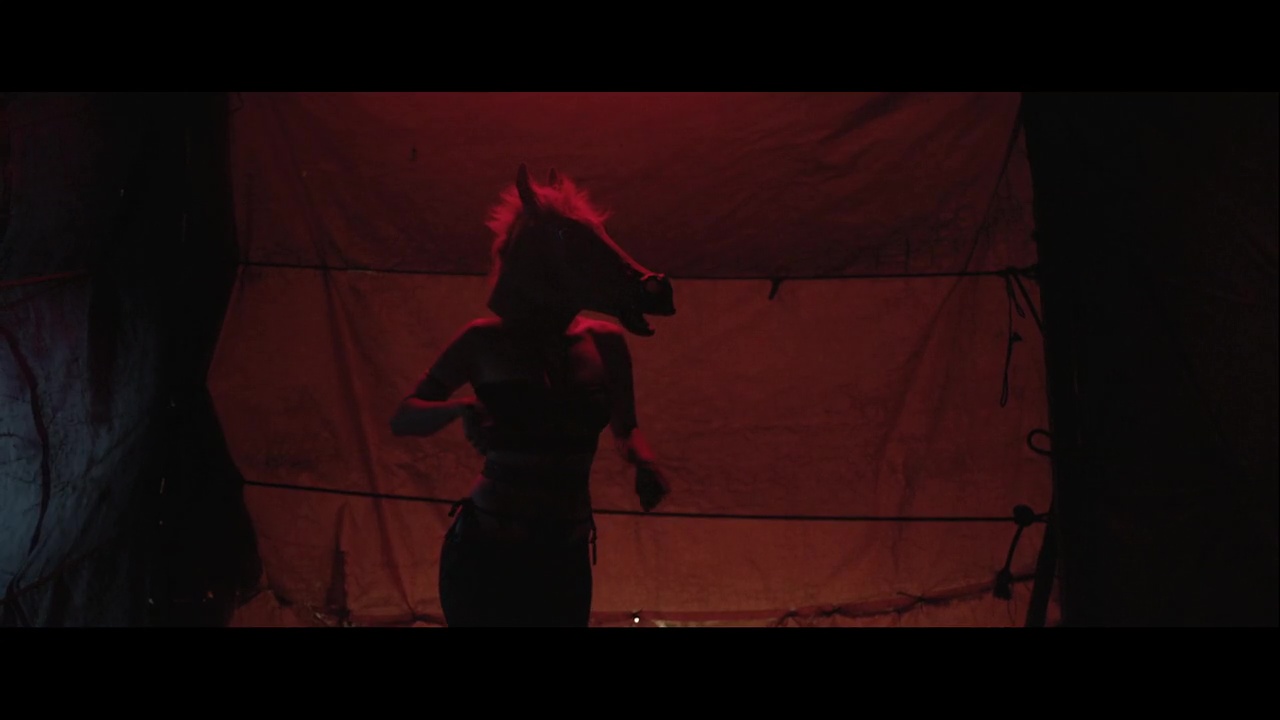 El inmundo de desechos y de paisajes devastados por la minería y otras formas de extracción a gran escala por el que navegan los personajes de Boi Neón pertenece a una zona del cine latinoamericano contemporáneo que en otra ocasión he llamado “neorregionalista”, en cuanto da la espalda a los cronotopos de pueblo y nación que apenas figuran aquí a título de restos obtusos, como las rocas pintadas con paisajes playeros en pleno sertón, promocionando un outlet de mallas baratas. El “carácter informe” que adquieren los ambientes y los cuerpos en ese contexto no se encuentra lejos de los “mundos originarios” que Gilles Deleuze atribuye al naturalismo cinematográfico en su libro sobre la imagen-movimiento (Deleuze piensa en Sternberg, en Stroheim y en Buñuel): entre los escombros del país-nación, el neorregionalismo abre la vista hacia un fondo a la vez local y global de vidas precarizadas, “o más bien –dice Deleuze– un sin-fondo de materias no formadas, borradores o pedazos, atravesados por funciones no-formales, actos o dinamismos energéticos que no reenvían a ningún sujeto constituído. Los personajes ahí son como las bestias…” (Deleuze 174). La animalidad se convierte, al re-ensamblar los restos obtusos de un mundo devenido informe, inmundo, en referente y repositorio para la construcción de cuerpos deseantes y deseados: un conducto pulsional en un tipo de ficción cuya lógica, dice Deleuze, ya no corresponde a la imagen-afecto del melodrama sin llegar a plasmarse tampoco en la imagen-acción del realismo y su secuencia de causas y efectos. La imagen-pulsión, en cambio, se contrae violentamente en “comienzos radicales y finales absolutos”, ya que “hace converger a todas las partes en un inmenso basural o pantano, y a todas las pulsiones en una gran pulsión de muerte” (Deleuze 174).
 La mujer de los perros (2015) de Verónica Llinás y Laura Citarella, en la que Llinás interpreta a una mujer que convive, en condiciones de precariedad extrema en los márgenes del conurbano bonaerense, con los perros abandonados que va recogiendo, ofrece una comparación interesante tanto con Boi Neón como con Serras da Desordem, en cuanto resalta el carácter simpoético de las alianzas e intimidades inter-especies en el inmundo. Aún más que en Boi Neón –donde la cercanía física constante entre reses, caballos y trabajadores en el establo incita también muestras de confianza, de cariño y hasta de solidaridad entre vidas igualmente sujetas a la explotación y la precariedad existencial– también aquí la relación humano-animal está marcada por un cuidado mútuo, una economía alternativa de afectos de la que ambos socios participan activamente. La mujer reparte entre la jauría los restos de comida que recoge de los desechos y el agua de lluvia que colecciona en un gran barril, pero también los perros le asisten en la caza de nutrias y pájaros en el monte y le brindan protección y calor a la mujer y a cada uno de los miembros de la pequeña comunidad. Podríamos pensar en el ensamblaje mujer-perros como ‘holoente’, que es la palabra que Donna Haraway forja en Staying with the Trouble para captar el devenir-con o ‘simpoiesis’ que es, según ella, el modo con-vivencial más frecuente entre ‘bichos’ (critters): no necesariamente una relación de ‘beneficios mútuos’, no un juego de suma cero, ya que no se trata primariamente de una relación económica sino afectiva (Haraway 60). Sin embargo, lo que sugiere también, y más que nada, la película de Citarella y Llinás es que recién esa relación simpoética produce, o tal vez rescata, nuevamente lo humano y lo canino a partir del ensamblaje de sobrevidas, de vidas-restos en el inmundo. Es la mirada animal y su carga de confianza y de responsabilidad la que impulsa a la mujer de mantener, aún en las condiciones de intemperie y de precariedad más adversas, una rigurosa rutina de ‘cuidado de sí misma’ y del pequeño refugio que ha construido para dormir, comer y hacer sus necesidades y su aseo personal, mirada que contrasta con la de adolescentes y trabajadores del centro de salud municipal quienes la vuelven a reducir a una condición de vida sobrante, de ‘vieja bruja’. Pero también es la disciplina rigurosa que ella impone sobre la jauría como cuando, al presenciar el abandono de un perro por su dueño en un estacionamiento, ella ata a los demás miembros de su comunidad para poder brindarle comida, cariño y tiempo al perro abandonado para permitirle tomar ánimo y acercarse: para, literalmente, reconocerse en los demás y tomar su lugar.
 Jens Andermann