El cine de la sobrevida

Cada semana, acá voy a postear un fragmento de algún texto reciente (y a veces no tanto) con el enlace a la versión completa. Hoy seguiremos con mi reseña de Nuestra tierra, la última película de Lucrecia Martel, que acaba de salir en el portal de la revista Kilómetro 111 (versión completa acá).

La cámara que sube por los aires, a vuelo de pájaro o incluso a bordo de un satélite orbitando la Tierra señala, en Eureka (2023) de Lisando Alonso y en Nuestra tierra (2025) de Lucrecia Martel, un giro hacia lo planetario, hacia las formas de destrucción y sojuzgamiento a las que, en un hemisferio como en el otro, han sido sometidos el monte, la selva y las praderas poniendo en peligro la continuidad misma de lo viviente. Pero en ambos films, lo que importa de verdad es hallar ahí abajo, en las pocas zonas en donde el verde no ha retrocedido aún ante las geometrías rígidas de agroindustria, minería y urbanización, los lugares de una sobrevida que tiene la forma de un constante redevenir-Indígena, en la expresión de Déborah Danowski y Eduardo Viveiros de Castro. Casi veinticinco años después de La libertad y La ciénaga, ambas estrenadas en 2001, donde forjaban desde geografías y poéticas fílmicas prácticamente opuestas una mirada sobre los márgenes de exclusión del ciclo neoliberal anterior en Argentina, en sus películas más recientes los dos directores más singulares de lo que fuera consagrado entonces como el “Nuevo Cine Argentino” se han volcado, de manera mucho más abiertamente política, a las luchas contra el etnocidio y el destierro que atraviesan de punta a punta a Abya Yala y a Turtle Island. Vuelo y aterrizaje: en los films más recientes esa dinámica entre espacio y lugar, si bien se plasma nuevamente en formas narrativas e incluso genéricas que no podrían ser más diferentes, inscribe esa tensión entre lo cada vez local y singular de las luchas por la tierra y la dimensión planetaria que, no obstante, hilvana todas esas singularidades (literalmente, en el caso de Eureka donde el vuelo de la cigüeña jabirú anuda los episodios separados en tiempo y espacio) como la cuestión candente de nuestra época.

Los dos films, asimismo, se construyen a partir y en contra de imágenes que ubican a lo Indígena como otredad arcaica y malvada, como obstáculo a ser removido, por la fuerza si es necesario, para que siga su curso el avance providencial de la Historia. Pero si Eureka comienza con un pastiche de la épica violenta del western clásico, solo para desmentir y denunciarlo enseguida como chatarra televisiva y cortar de la mitología en blanco y negro de los vencedores al color y al suplicio de los sobrevivientes en la intemperie de la reserva, Nuestra tierra parte de otro tipo de filmación, en tiempo real, para extenderse de ahí a temporalidades históricas y biográficas más largas, atravesando generaciones e incluso siglos. Se trata, nada menos, de las imágenes grabadas por uno de los perpetradores –Sergio Amín, “el Turco”, latifundista y minero tucumano– del asesinato de Javier Chocobar, cacique de la comunidad diaguita de Chuschagasta, ocurrido el 12 de octubre de 2009 en la localidad de El Chorro, a medio camino entre la capital provincial y el límite con Salta. Es hacia ahí que se dirigía, aquel día fatídico, el terrateniente (que también cobraba un sueldo como asesor de la división provincial de patrimonio histórico), acompañado por Luis Humberto “El Niño” Gómez y Eduardo Valdivieso, dos ex policías e integrantes de fuerzas paramilitares, al encuentro del grupo de comuneros que solían vigilar y registrar fotográficamente las incursiones a las tierras sobre las que habían presentado ya cantidad de recursos y amparos legales. Fuertemente armados, Amín y sus guardaespaldas también habían traído al encuentro una cámara de video para registrar las “provocaciones” de los comuneros, y el encuentro de ambos bandos, aún antes de las palabras que luego derivan a los empujones y finalmente los tiros que dejan muerto al cacique y con heridas graves a otros tres campesinos chuschas, comienza como una querella de imágenes, con la cámara de Amín enfocando al comunero Delfín Cata que lo registra con su pequeña cámara análoga de fotos. La secuencia, pues, tiene características fílmicas: un plano, un contraplano – solo que, en el video, este último solo figura como ausencia marcada, con la cámara plantada firmemente atrás de Valdivieso, el ex agente, quien va al frente con actitud amenazadora exigiendo explicaciones y, acto seguido, saca su pistola y empieza a disparar, primero al aire y luego a matar. Es ahí que, cuando Amín se larga a correr y la cámara, colgada de su cuello, sigue grabando, el encuadre pierde foco y nitidez mientras la “acción”, fuera de cuadro, continua en la pista sonora (con una voz preguntando, como si se hiciera eco de la nuestra, “¿qué pasa? ¿qué pasa?”).

El caso Chocobar, como llegó a conocerse en los medios, tenía, pues, forma cinematográfica mucho antes de que Lucrecia Martel se interesara por él: estaba, de algún modo, hecho para las cámaras aun antes de que, deliberadamente o no, las cosas (y la cámara) se les “fueron de las manos” a Amín y sus secuaces. Es más, tenía, de algún modo, la forma cinematográfica de una película de Lucrecia Martel donde, como el tiro en el monte en La ciénaga que puede o no haber dado en el blanco, los momentos claves suelen ocurrir fuera de pantalla o al menos de la zona de nitidez que enfoca la cámara, para ser registrados de modo ominoso, incierto, por la banda sonora. De ahí que, para quienes seguíamos los films de la cineasta salteña, no se trataba tanto de volver a atar los cabos que ese desencuentro entre imagen y sonido a menudo dejaba sueltos que de aprender a convivir con una multitud de momentos y devenires paralelos que, en vez de refluir todos hacia una sola corriente principal, más bien formaban ahí motivos o constelaciones a manera de una partitura orquestal o del tejido de una manta en el telar. Así también en Nuestra tierra, aunque aquí ese juego formal de tiempos múltiples adquiere asimismo una dimensión inmediata y profundamente política: de un lado, está el tiempo teleológico del proceso judicial, al que la cámara y el micrófono de Martel asisten en clave rigurosa de un documental de observación – o más bien, los dos tiempos que activa el tribunal que recién se inicia a nueve años de la muerte del cacique, pues en su secuencia de audiencias, testimonios y “reconstrucciones” in situ, el juicio también vuelve una y otra vez, insistentemente, al tiempo y lugar del crimen que las cámaras habían fallado en captar en su momento de ocurrencia. Del otro, está la película de Martel donde, por el contrario, la falla, el desvío, se constituyen en un principio poético, en el sentido de dejarse llevar por los guiños y sobreentendidos que atraviesan el juicio y de seguirles la pista que lleva invariablemente hacia fuera de la sala de tribunal y al encuentro de otros relatos y temporalidades, ancladas en fotos de familia, ensayos musicales y en los tiempos de siembra y cosecha que marca el calendario de las fiestas religiosas. Es decir, hacia los tiempos de la tierra y del destierro, de exilios y regresos y de memorias que se hilvanan hasta formar un orden, una constelación: un lento redevenir-Indígena que acontece en conjunto y a raíz de la lucha por la tierra, en un solapamiento de tiempos que es distinto al que despliega el relato judicial y hacia el que va abriéndose Nuestra tierra.
[Seguir leyendo en Kilómetro 111]

#MileiNo

Carta abierta de investigadorxs internacionales por la democracia y los derechos humanos

Acabamos de lanzar una solicitada para defender el proceso democrático en Argentina, hoy en peligro grave ante la posibilidad de que un candidato negacionista de ultraderecha gane el balotaje presidencial del próximo domingo 19 de noviembre. Ya firmaron más de 800 colegas en cinco continentes resaltando las “políticas suicidas” de la fórmula neofascista y defendiendo los valores de verdad, memoria y justicia como pilares fundacionales del pacto democrático.

El texto completo y la lista de firmas puede consultarse aquí en versión castellana y aquí en versión inglesa, junto con la lista de firmantes, y con un enlace al formulario de adhesión.

Aquí se puede leer una nota que sacó Página/12 sobre la iniciativa: https://www.pagina12.com.ar/616362-no-a-milei-carta-abierta-de-academicos-de-todo-el-mundo

The end of transition: working notes

I wrote the following notes for the closing round-table of the symposium “Performing Human Rights: Contesting Amnesia and Historical Justice in Latin America and the Middle East”, University of Zurich, June 28-29, 2018. Because of the quite lively discussion these remarks provoked, I share them here as an invitation to think and discuss further. I thank the conference organizers, Liliana Gómez-Popescu and Bettina Dennerlein, for challenging me to return to the question of transitional justice and human rights.

Screenshot 2018-06-30 19.20.12

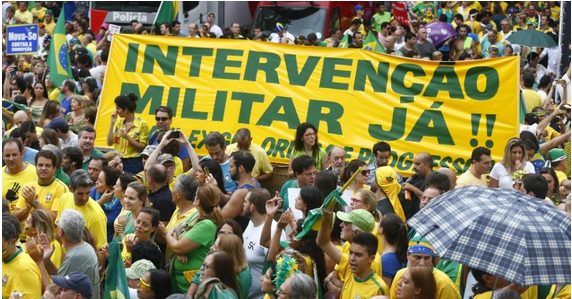
Anti-PT manifestation, Brazil, 2015 (photo: blog União da Juventude Socialista)

Coined in the legal and political sciences in the 1980s and 1990s, especially in the ambit of international organizations, the concept of transitional justice was tasked with managing governance in contexts of negotiated handovers of state power from “authoritarian” to “democratic” governments, in contexts that ranged from Latin America’s Southern Cone to the end of apartheid in South Africa to the rapidly disintegrating map of post-Soviet Eastern Europe. The very notion of a “return to democracy” frequently associated with discourses of democratic transition also framed the latter as a universal, normative standard that had been interrupted by authoritarian exception. Transitional justice, a label that was quickly being applied to postgraduate programs and government agencies the world over, offered a framework for comparing –that is, for measuring the relative success or failure within the quantifiable parameters of benchmarks, indices and goalposts held dear by governments and international institutions– processes of compartmentalizing the political contingencies of these “transitions” into discrete, and partially autonomous, institutional realms. Transitional justice, in short, ensured the reconfiguration of politics as administration, and it did so, centrally, in parsing out, on the one hand, more or less limited forms of legal prosecution of human rights violations (frequently reparative rather than retaliatory), and on the other hand the opening-up of institutional settings for the productions of testimony, where victims’ memory performances could be played out within “safe spaces”.

Admittedly, I’m offering a schematic, even caricaturesque, summary here of processes which, at a national or even local level always played out in much more complex and contradictory ways — but the point here is, precisely, that transitional justice, as an imaginary gold standard of such diverse processes, openly promoted itself as an enabling fiction, one to which the political itself had to succumb, it was suggested, in order to be able to unleash its potentiality and contingency once again once the “transition process” had been successfully completed.

In Latin America, this notion of transition and the historical narrative of normalcy and aberration it implicitly subscribed to, have been submitted from very early on to a radical critique and counter-narrative that has been associated with the concept of postdictatorship, that is, with the various modes of dictatorial afterlife the idea of transition both obscured and enabled. For what if not dictatorship has been the “transitional” moment that violently separates, in Latin American late modernity, the increasingly radicalized national-popular movements and governments of the 1960s and 1970s from the neoliberal regimes that succeeded, or perhaps rather, were ushered in by, military State terror? Against the origin myth of democratic continuity interrupted by authoritarian exception, tantamount to emptying history of politics, postdictatorship proposed a narrative of catastrophic defeat, of which the discourse of democratic transition was itself symptomatic: transitional justice, as the legal-institutional administration of (neoliberal) governance “after terror” confirmed the successful violent destruction, and inability to suture or reconstruct in the present, of the languages of decolonizing emancipation the dictatorships had violently cut short.

The rise and fall of center-left governments in Latin America after the millennium (the so-called pink tide) can thus also be understood, in retrospect, as a failed attempt to re-introduce the political into the empty time of neoliberal administration, constituted upon the discursive and institutional frameworks of “democratic transition”. Yet what this failure has presently unleashed is a wave of necropolitical vengeance that far exceeds the mere reinstatement of the neoliberal status quo ante. Instead, I suggest, the open instrumentalization of lawfare for political ends and the cynical tweaking or outright violation of constitutional norms (as in Honduras, Paraguay or Brazil) on behalf of a resurgent right mark the true “end of transition”, in the sense not just of the completion of a cycle but also, and foremost, as revealing the political and historical ends the former was always already transitioning towards.

The end of transition, if indeed we were to think of the present moment in Latin America under this heading, would then imply a range of challenges to critical thinking and the politics of resistance alike. I want to sketch out just two: firstly, beyond the critique of the political and legal underwritings of transitional governance the notion of postdictatorship has allowed us to perform, we would urgently need to expand our frameworks today towards a more systematic, longue durée point of view that would allow us to encompass (as fundamental) the economic dimension of “transition”. What “transition” will have turned out to have transitioned towards, what it literally prepared the ground for, would then take shape as a violent, even genocidal, neo-extractive cycle currently rolling across the Global South and beyond, and of which the racist, misogynistic, and homo/transphobic necropolitics of the dominant neofascism in the Americas are part and parcel. What we need is a reframing and retooling of our critical instruments in order to be able to name the way in which dictatorial terror and neoliberal accumulation-through-dispossession alike participate of an extractivist matrix that takes bodily and earthly surfaces –the living and the material– as “overburden” and as targets of its extractive bio- and necropolitics. It is no accident, after all, that indigenous persons and women have presently emerged as the principal agents of resistance, and as the main targets of fascist violence, as the assassinations of Heather Heyer, Bertha Cáceres and Marielle Franco in the United States, Guatemala and Brazil, or the illegal imprisonment, torture and assassination of Kolla and Mapuche leaders in Argentina and Chile show all too eloquently.

Secondly, perhaps the field of memory studies as presently configured has neglected for too long, and to its own peril, the way in which the neofascist resurgence has itself been underwritten by “memory performances”, from the various kinds of ritual homage paid to icons of white suprematism and slavery in the U.S. South to the mobilizations of perpetrators’ relatives and their political and mediatic allies in Brazil, Argentina and Chile, which once more openly defend military tortures and assassinations perpetrated, the story now goes, in the sacrificial defense of the nation against leftist “corruption”. In what ways, we need to ask, have the “subjective” and “performative turns” in memory studies, as developed within ethical imperatives of empathizing with the experiences and demands of victims, been neglecting these memory performances of the enemy? Has the privileging of memory over history, however important in contexts of recovering experiences of suffering and resistance, suddenly left us exposed against the fascist rewriting/reperforming of the past? The challenge for the Left today, it seems to me, is then about moving beyond extant critiques of the transitional consensus as outlined above, and towards a more comprehensive engagement with what transition was actually heading towards.