Luis Fernando Benedit: Invisible Labyrinths

Talk at the Institute for Studies on Latin American Art (ISLAA), January 18, 2025

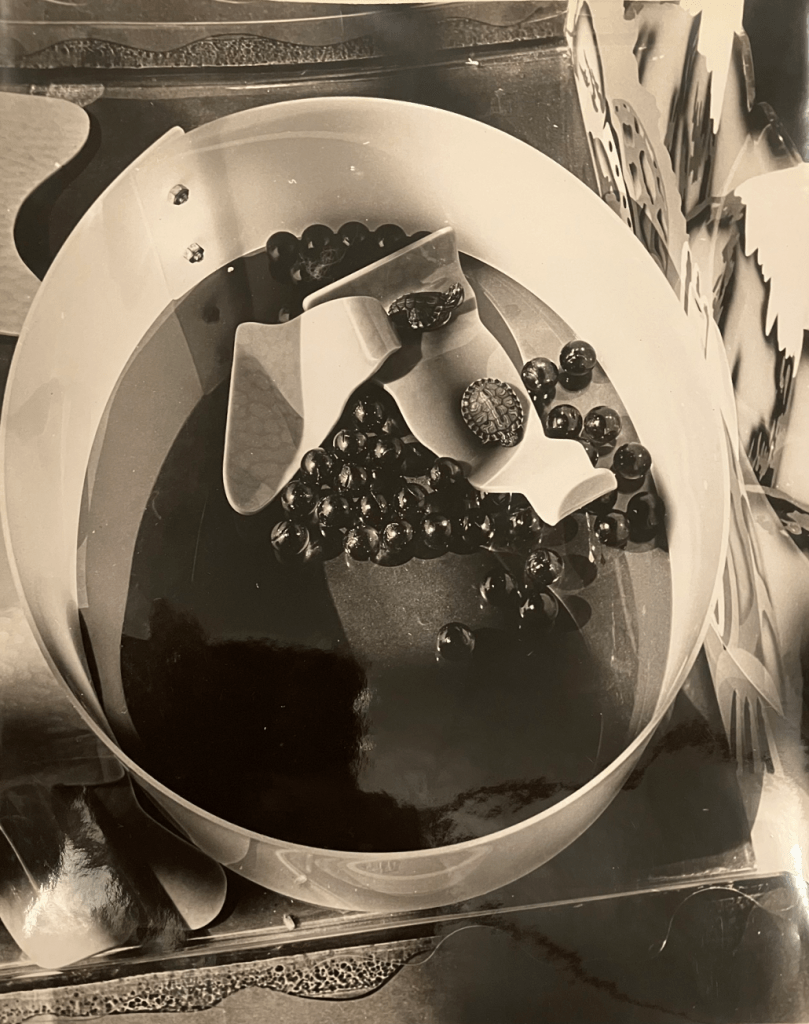
Can we take Benedit seriously? Or is his work more of a joke, a one-liner that has gone stale? Or, conversely, is there more to the lightness and humor than meets the eye? In 1968, just months before Tucumán Arde –a milestone of Latin American political art– and practically simultaneous with the first showings of Hélio Oiticica’s parangolés in Brazil, Benedit’s Microzoo show at Galería Rubbers, Buenos Aires, featured a series of pieces that adopted, as did Oiticica’s, the form of the habitat-labyrinth at the same time as it reflected on the interface between communicational stimuli and patterns of behavior. But rather than, as in Tucumán Arde, tackling these issues by attempting to short-circuit neocolonial-capitalist ideology using the disruptive strategies of avant-garde art or, as in Oiticica’s post-concretist work, wager on the sensorial immersion of the spectators-participants, with the artwork as a kind of catalyst triggering individual and collective ways of being-otherwise, Benedit’s work, at least at first glance, appeared to take us away from what Roberto Jacoby describes as the galloping race, in less than half a decade, from the formal concerns of minimalist abstraction to the outright juxtaposition of art and politics in Latin America. Microzoo, instead, contained artificial habitats for living organisms including a plexi glass anthill and other receptacles for lizards, fish and turtles, as well as small nurseries for plants in different states of germination. The provision of light and food imposed on these certain types of behavior in conditions of an artificial environment, the learning of which visitors could observe as it occurred. In Benedit’s own words:

My animal and plant habitats are biological sculptures. There is a definite relationship between the forms and their inhabitants (mice, ants, fish). They reflect both the forms I wish to create and the needs of the plants or animals for which they are intended, and thus each work can be seen on several levels. […] I think of them as ecological objects where the balance of interacting elements is created artificially. Ecology as a field of concern is important to me as an artist, as indeed it must be to anyone who has thought about it. What I am trying to do is to focus on it and draw attention to it. (Benedit 1976: 20)

Luis F. Benedit, Habitat for water turtles (1968). Courtesy ISLAA archive.
Now, this supposedly didactic nature of the habitats and labyrinths raises several questions. Who exactly is the one “learning” from the device? Is it us spectators or rather the non-human beings who adapt their lives to the conditions of the artifice? In other words, if there is something we can learn from other existents’ learning, is this lesson really about the natural order or not rather about its accomodation to artificial conditions? But also, how is this behavioral modification different from our own aesthetic response to the artwork, if plants and animals effectively forge from their encounter with the “ecological sculpture” new ways of being in the world? Are they the real connoisseurs?

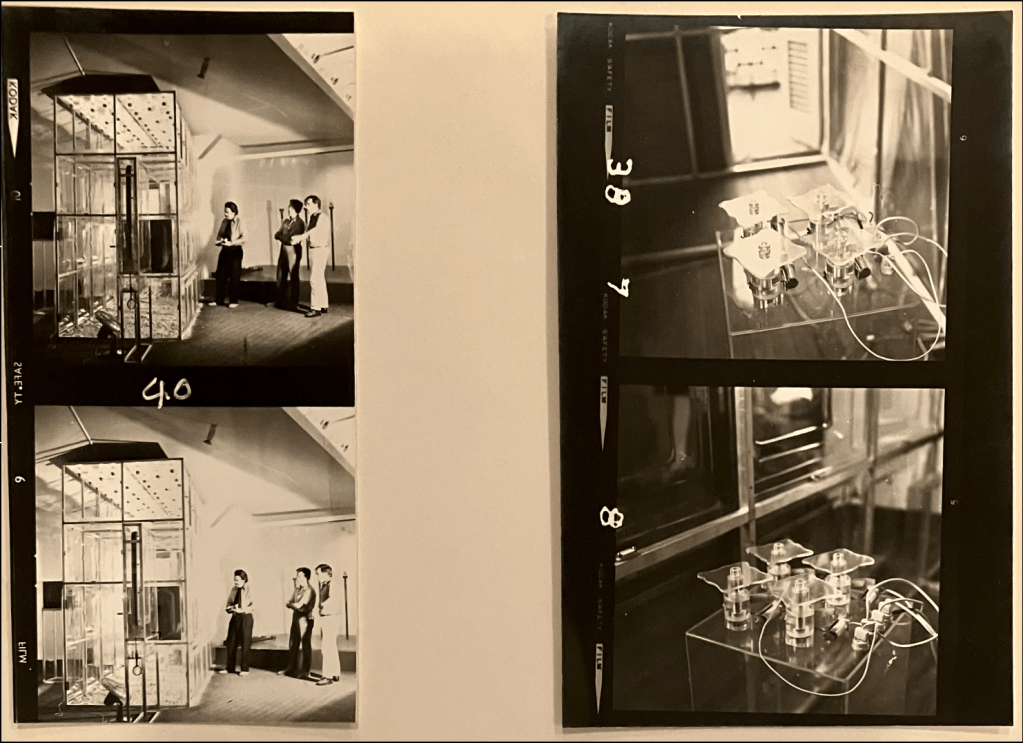
Effectively, then, we might think of the successive phases in Benedict's work as early forerunners of bioart and ecoart, and thus as “political” in their own, anachronistic fashion. In 1971, returning to Italy where he had previously completed a degree in landscape architecture, Benedit exhibited Biotrón at the Venice Biennale, created together with the biologist José Nuñez and which, after the exhibition was over, was reinstalled at the Faculty of Exact Sciences of Buenos Aires University. It consisted of a transparent plexi and aluminum frame containing at one end a transparent honeycomb with four thousand live bees for which, inside the receptacle, an “artificial meadow” with electronic flowers secreting a sugary nectar, provided nutrition. At the opposite end was an exit tube to the Biennal’s gardens, allowing the bees to choose between foraging for food outside or staying inside feeding on its artificially generated equivalent.

Installation of Biotrón at the Venice Biennial, 1971. Courtesy of ISLAA archive.

The following year, on occasion of his solo show at MoMA, Benedit premiered Fitotrón, a device where, through the manipulation of the variables of light, humidity and temperature, one could observe the plants’ reactions in their adaptation – or not – to these environmental changes, a proposal the work shared with Laberinto vegetal, from the following year, a black plexi box with germinating seeds at one end and a forty-watt lamp at the other. In their growth towards that light source, triggered by phototropic attraction, the plants had to navigate an itinerary that branched into two alternative paths (right/left), leading them either to death or survival.

Luis F. Benedit, Laberinto vegetal (Plant Labyrinth, 1972). Cover page of Projects and Labyrinths, Whitechapel Art Gallery, London, 1975.

The disconcerting, even revulsive effect these works provoke had to do, it seems to me, not just with having living beings in museums and galleries (instead of their usual places of residence in the human environment such as laboratories, gardens or zoos). Rather, it stems from the provocative confusion between artistic and scientific modes of encompassing and containing those lives. The opposition that gives this work its constitutive tension is not, or not only, that of nature and artifice; rather, it is the distinction between different forms of artifice and their respective effects of nature. Biotrón is perhaps where this difference between regimes of artificiality is most clearly marked: the point here is not there, as art historian Carlos Espartaco (1978: 13) claims, about “making [the bees] fluctuate between a natural environment (gardens) and an artificial one (the biotron)” because a garden is of course no less an artificial medium than an electronic meadow, only it belongs to a different regime of administration of the living. Rather than a contrast between nature and artifice, the Biotrón stages a reflection on the senses of the natural that a certain artificial order entails. Between the artificial landscape of the garden and the electronic meadow, we move from a relationship mediated by representation as imitation to one of substitution of certain relations and functions, that is, to what Tom Mitchell calls “the age of biocybernetic reproduction” (Mitchell 2003: 483-84).

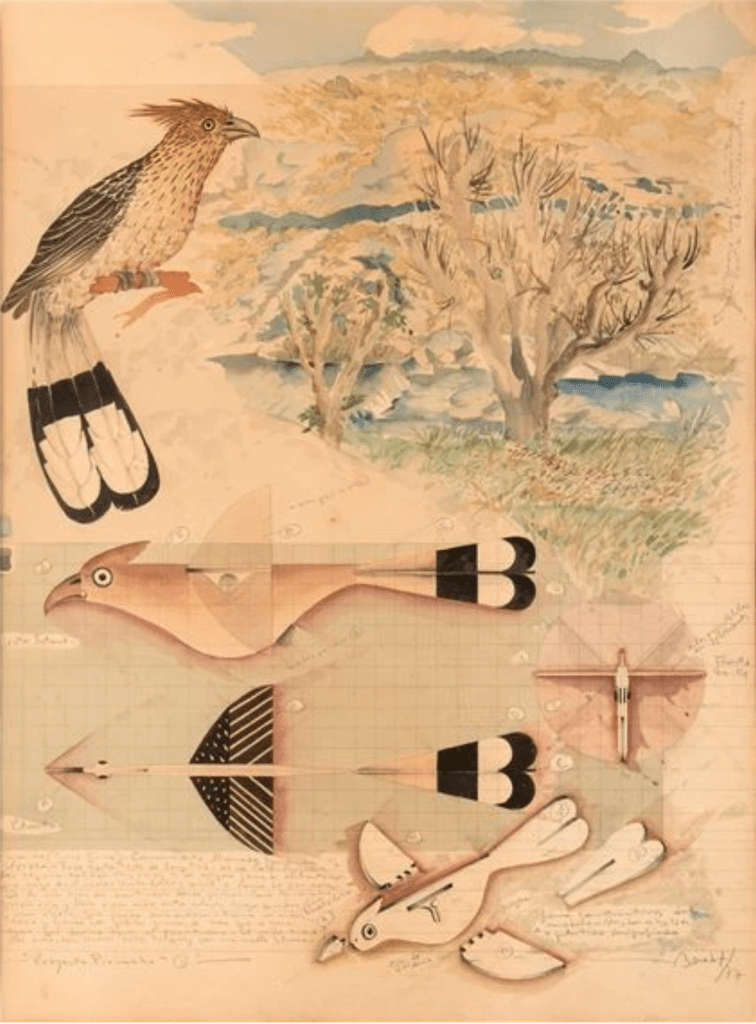
Luis F. Benedit, Proyecto Pirincho I (1977). Pencil and watercolor. Courtesy of ISLAA.

In his later work, Benedit would highlight this archaeological dimension of investigating the modern regimes of nature. After Laberinto vegetal, he effectively stopped working with living organisms to dedicate himself instead to their analytical “despiece” or “dismantling”: thus, in a series of drawings of Argentine birds, the pencil and watercolor technique of nineteenth-century naturalism is juxtaposed with the technical drawing, which “reconstructs” the flying organism through complex robotic mechanics. There is also a return to the objectual dimension as in Furnarius Rufus from 1976 –a wooden frame with an ovenbird’s nest containing an embalmed bird– and on to the collection or the museum as in Campo (1978), a kind of “Exposición Rural” or agriculture show documenting the human-animal assemblage of production mediated by biotechnology. In paintings, photographs, glass and wood containers and objects modeled in resin, this museum of Pampean biopolitics subjected to a similar kind of analytical “despiece” as the bird-robots an entire regime of human-animal life, broken down into individual elements such as a set of boleadoras, batons, stirrups, bridle and muzzle, castrating scissors and the photo of a dead pedigree bull next to the artificial insemination pills in which its frozen semen remains preserved.  In the following decade, Benedit would go even further back in his archaeological approach, turning to the pictorial production of the Pampa landscape and 'recreating' works by nineteenth-century artist León Pallière such as Un nido en la pampa, Indios del Gran Chaco and El payador (1984-85), among others. Rather than an expression of rural nostalgia, this return to “picturesque” landscape dismantles and reassembles it as one more technology for the administration of the living, an analytical “dismantling” to which Benedit subsequently also submits the Patagonian expedition of Fitz Roy and Darwin (1831-36) in his multi-installation and artist’s book From the Voyage of the Beagle (1987).

Luis F. Benedit, Tijera de castrar (Castrating scissors, 1978). Centro Cultural Recoleta, Buenos Aires.

Following the path opened by Benedit, today’s bio and ecoartists are also frequently a kind of archaeologists of the scientific forms of capturing and transforming life. By introducing an aesthetic kind of self-reflexivity into the spaces, procedures and terminologies of the “natural sciences”, bioart and ecoart also call into question the founding biopolitical division of modernity, the divide between nature and culture according to which, as Bruno Latour has argued, the essential truth of nature can be revealed to scientific reason precisely on condition of remaining absolutely external to the cultural (Latour 1993: 104-05). Hence, Benedit’s early “invasion of the laboratory”, his reenactments of the scientific procedures of the experiment, the journey and the collection, also have a (bio)political dimension, in their production of unspecific discourses and statements: these works do not become science, but neither can they be clearly assimilated to art in terms of their procedures and formal affiliations, nor, finally, can they be reduced to political messages of ecological militancy or criticisms of biotechnology. Science, art and politics come into play here in a deliberate un-specification of the artwork’s objectual form and institutional location. Perhaps we should, in fact, think of its aesthetic dimension, if we still wanted to call it that, more than anything as that vector of unspecification the material and discursive arrangement of Benedit’s works project, which is why the dimension of irony and laughter is not coindicental but actually key here: it allows us to make light of the art-science border, to the effect that the living spills out over them.

References
Benedit, Luis Fernando. Plant- en dierhabitatten . Antwerp: Internationaal Cultureel Centrum, 1976.
Espartaco, Carlos. Introducción a Benedit. Buenos Aires: Ediciones Ruth Benzacar, 1978.
Latour, Bruno. Wer Have Never Been Modern. Cambridge, MA: Harvard University Press, 1993.
Mitchell, W. J. T. “The Work of Art in the Age of Biocybernetic Reproduction,” Modernism/Modernity 10, 3 (2003): 481-500.

For a more extended discussion of Benedit’s work, see my Entranced Earth: Art, Extractivism, and the End of Landscape (2023).

Jose Alejandro Restrepo: Paso del Quindio I (1992)

Charla presentada en MoMA, 18 de julio de 2024

José Alejandro Restrepo, Paso del Quindío I (vision general). Foto J.A.

El paisaje fue la “entrada” de América Latina al arte occidental: en otras palabras, fue el aparato plástico, cultural, político y epistemológico que produjo al “Nuevo Mundo” como una tierra objetivada, disponible tanto para la mirada del observador externo al cuadro como para la acción extractiva del colonizador de ultramar.  De esta manera, la crítica del paisaje (como también la del cuerpo en tanto objeto de una mirada exotizante), en el arte latinoamericano contemporáneo ya es de por sí una operación metacrítica, en el sentido de reflexionar no solamente sobre las implicaciones de un género particular sino también sobre las tensiones entre “arte” y “Latinoamérica,” esto es sobre las condiciones de participación, a título de regionalidad subalternizada, en un marco institucional clave (junto con la escritura y la ciencia) de producir a las Américas como objeto colonial.

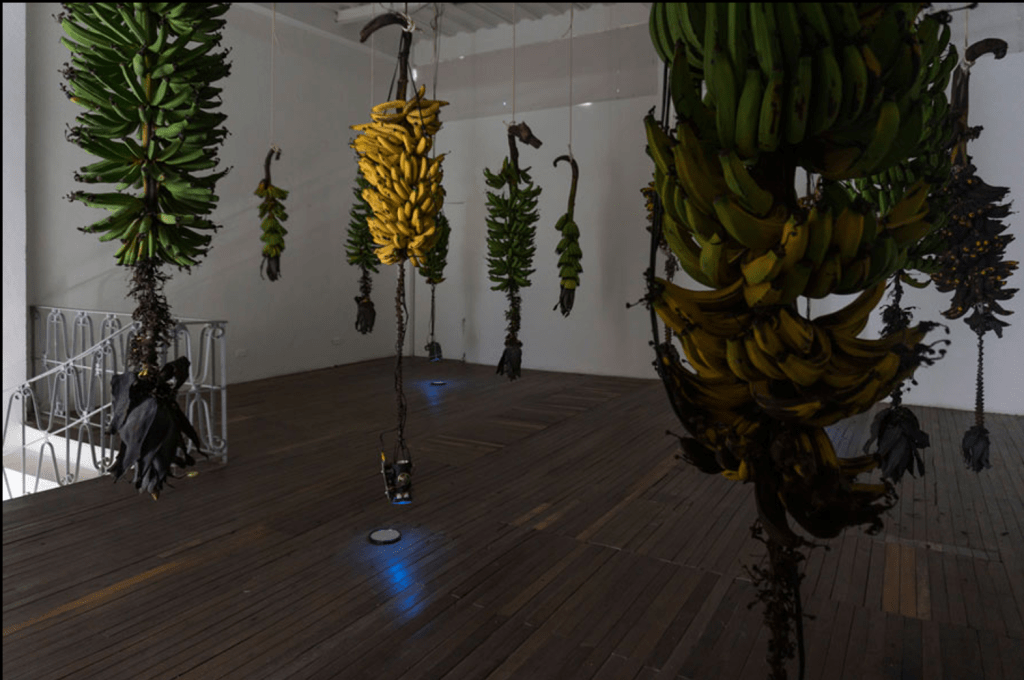
José Alejandro Restrepo, Musa Paradisíaca, 1994. (FLORA arts + natura, Bogotá, 2016)

La primera sala de Chosen Memories desafía en este sentido (como lo hace a su manera toda la muestra) a su propio entorno físico e institucional. Al poner en cuestión la forma del paisaje, también reflexiona críticamente sobre la inscripción de lo latinoamericano en un museo (este en particular pero también el “museo occidental” como forma y como marco más generalmente) que ha no dejado de ser un museo colonial en su manera de distribuir “regionalidades”.

Paso del Quindío I, la instalación de José Alejandro Restrepo realizada originalmente en 1992, forma parte de una obra que ha hecho de la escenificación de tensiones uno de sus ejes principales. Puede leerse en serie con obras como Musa Paradisiaca (1994) o El cocodrilo de Humboldt no es el el cocodrilo de Hegel (1994), ambos de los cuales también reflexionan sobre la producción, como idea y como realidad material, de la naturaleza tropical. Se trata de 17 monitores distribuidos en forma de pirámide y “en perspectiva”, armando unas líneas de fuga hacia atrás, que emiten en un loop de aproximadamente media hora imágenes grabadas en la sierra colombiana del mismo nombre.

La obra es, voy a argumentar, a un mismo tiempo una crítica y un homenaje: crítica del paisaje como aparato de captura y así también del lugar de América Latina en el museo colonial. Pero también homenaje a Alexander von Humboldt y al cruce multidisciplinario y multisensorial de prácticas estéticas y científicas que la “historia natural” en movimiento y en primera persona que practicaba supo movilizar forjando de manera precoz una suerte de estética ambiental que aún hoy mantiene su potencial innovador.

En el primer sentido, de crítica desconstructiva del paisaje como marco, la forma piramidal del conjunto y la fuga en perspectiva de los monitores parecieran duplicar la ilusión mimética subyacente a las imágenes en blanco y negro que proyecta cada pantalla: la montaña que se estaría atravesando. Pero al mismo tiempo, la revelan a ésta como efecto de un juego de perspectiva. El efecto de ruptura es así tan sencillo como eficaz, ya que el “paisaje” invocado por los monitores no coincide con el que éstos proyectan. Al duplicar su geografía montañosa, la instalación expone la artificiosidad de las propias imágenes, como un tipo de producción y no de reproducción del espacio.

José Alejandro Restrepo, Paso del Quindío I (detalle). Foto J.A.

En segundo lugar, los loops que proyecta cada monitor no coinciden exactamente: la imagen-paisaje se desconstruye también porque unos monitores están a destiempo respecto de los otros, aunque no siempre los mismos obligando a nuestra mirada a ir y venir constantemente de uno a otro. La visión simultánea, totalizante, del observador del paisaje-cuadro que el teórico de arte Norman Bryson ha llamado “la percepción fundante” está denegada aquí por la no simultaneidad de las imágenes en pantalla.

El tercer aspecto de esta desconstrucción del efecto mimético pertenece a la la musicalización, a la pista sonora que consiste en una edición electrónica de cuatro notas en clave menor tocadas por el violonchelista chileno Eduardo Valenzuela. El sonido propone así un contrapunto a la sucesión de formas y motivos en la pista visual: plantas, nubes, rocas. Como ha sugerido Restrepo, “el sonido como material plástico” agrega una dimensión no mimética, abstracta, a la secuencia visual. No se trata de música programática –a la manera de las sinfonías pastorales de Beethoven o de Smetana, músicas que narran el paisaje– sino que en su extrañamiento electrónico de la fuente sonora análoga (el violonchelo), la pista sonora más bien remite al acto expectatorial y oyente de presenciar la obra (remite a la instalación, no su contenido).

José Alejandro Restrepo, Paso del Quindío I (detalle). Foto J.A.

Y finalmente, la propia imagen-paisaje (la secuencia de vídeos en blanco y negro) se desbarranca, o se abisma hacia adentro, en forma de un segmento de 4 a 5 minutos que sigue a una pantalla en blanco más o menos en la mitad del loop y por tanto correspondiente al límite entre “subida” y “bajada,” al momento del “Paso del Quindío” propiamente dicho. Se trata de una secuencia de paneos laterales aceleradísimos sobre vegetación a ras del suelo, como si la propia mirada estuviese cayéndose hacia adentro de la imagen o desprendiéndose del soporte implícito de un cuerpo observador humano para convertirse más bien en visión abstracta, pura. Alguna vez, al estudiar el cine de Lisandro Alonso, una de cuyas tomas características son también unos “bailes” alocados de una cámara liberada de cualquier función diegética así como de la mirada antropomorfa subyacente al cine narrativo, traté de pensarla a esta secuencia como una puesta en trance de la relación entre cine y ambiente en que se abren líneas de fuga para una potencial mirada de un pájaro, un insecto o incluso del mismo viento. Es decir, ahí como en la obra de Restrepo habría algo así como una des-objetivación del entorno visible que se transforma en agente mirador.

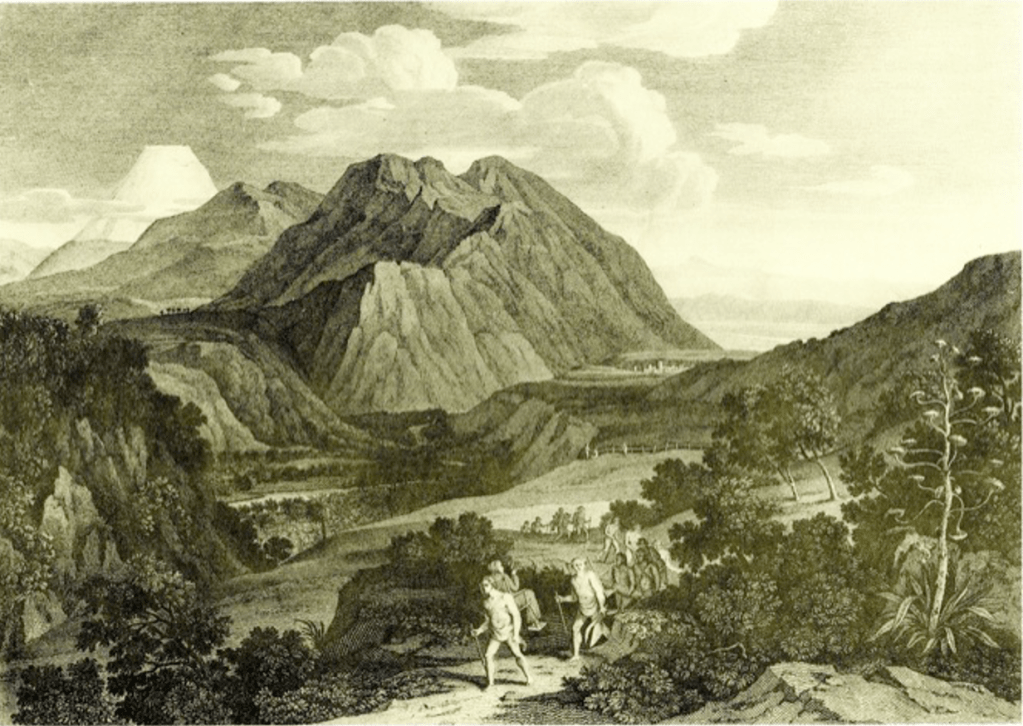
Esta secuencia central me lleva a la dimensión del homenaje. El Paso del Quindío I referencia desde su título a la tabla número 5 de Vue des Cordillères et Monuments des Peuples Indigènes de l’ Amérique, “Passage du Quindiu, dans la Cordillère des Andes,” un diseño realizado en Roma por el pintor Koch sobre un bosquejo hecho por el propio Alexander von Humboldt diez años antes en Colombia y luego convertido en grabado en Stuttgart por el impresor Duttenhofer quien luego lo mandó a la imprenta F. Schoell en París. La imagen, uno de los 22 paisajes mexicanos y andinos que componen el libro junto con otras imágenes referentes a 23 obras precolombinas, es una de las más famosas de todo el volumen, acompañada además por un breve texto del propio Humboldt que oscila entre el desglosamiento de los aspectos geológicos, botánicos y socioeconómicos del área representada y la narración de la propia expedición de la cual el grabado representa una suerte de compendio o de síntesis visual.

Alexander von Humboldt, Passage du Quindiu dans la Cordillère des Andes, en Vue des Cordillères et Monuments des Peuples Indigènes de l’ Amérique (1810-13)

“Passage du Quindiu,” entonces, ya era (como después lo será El Paso del Quindío I) un ensamblaje multimedial que yuxtapone, en una coyuntura  tecnológica anterior a la de Restrepo, varios tipos de producción visual y textual, en función de rendir la experiencia del lugar, no como objeto monádico y disponible, sino como una suerte de archivo abierto y con múltiples niveles, o sea como “material de estudio”. Como propone Oliver Lubrich, “para Humboldt, los paisajes son simbólicos y políticos. Se vuelven objetos de apreciación estética y de precisión política. El paisaje representa un desafío a la interpretación post-disciplinaria. Se transforma en un ecosistema avant-la-lettre. Se torna acústico. Y genera la visión democrática de una instalación multimedial pública”.

“Passage du Quindiu,” más particularmente, según Lubrich es un dibujo multiperspectívico que permite al observador elegir uno de los diversos puntos de vista que sugiere: desde la información geobotánica sobre la prevalencia de ciertas plantas en relación a diferentes alturas a las formaciones orográficas de las rocas (aspectos sobre los cuales también enfoca el lente de Restrepo), a dimensiones climáticas como la línea de nieve. Pero el cuadro también focaliza sobre la situación política y social en que se inscribe el viaje –esto es, el contexto de producción de la propia imagen– en la figura de los cargueros y sus pasajeros sentados en la silla atada sobre sus espaldas. Mientras éstos últimos están vestidos con atuendos europeos y aparecen con la vista fija en un libro, estos andan casi desnudos, descalzos y mirando hacia adelante — sobre todo el segundo carguero de la fila cuya mirada se encuentra con la nuestra, esto es, con el punto de vista implícito de Humboldt quien se negó a viajar cargado en una silla y así puede ocupar un lugar externo, de observación de las relaciones de clase y poder entre cargueros y pasajeros.

Concluye Lubrich que “la imagen parece demandar una interpretación alegórica: si el hombre mirando hacia atrás quien está siendo cargado representa a la élite blanca reaccionaria o, como lector que permanece impermeable al mundo, a la percepción colonial de los viajeros europeos, entonces los cargueros son representativos de la población indígena subyugada.”

José Alejandro Restrepo, Paso del Quindío I (detalle). Foto J.A.

Sea como fuese, El Paso del Quindío I incluye, casi literalmente a modo de nota al pie, un homenaje explícito a Humboldt. Este tiene la forma de los dos pequeños monitores al pie y a cada costado de la pirámide dónde, contrastando con la secuencia de vistas que transcurren por las pantallas más grandes, se ve una serie de planos cortos (close-ups) sobre la vegetación cercana al suelo; sobre todo los tallos y hojas espinosas de caña que, como contaba Humboldt en su texto, prolifera en la barranca occidental de la cordillera y terminaba por destruir el calzado de los viajeros, obligándolos a andar descalzos como todos los que atraviesan de pie y no en silla de carguero la montaña. Y es este, el del caminante, el punto de vista que nos solicita ocupar también la obra de Restrepo: nos urge que caminemos hasta allí donde el paisaje se abisma.