Luis Fernando Benedit: Invisible Labyrinths

Talk at the Institute for Studies on Latin American Art (ISLAA), January 18, 2025

Can we take Benedit seriously? Or is his work more of a joke, a one-liner that has gone stale? Or, conversely, is there more to the lightness and humor than meets the eye? In 1968, just months before Tucumán Arde –a milestone of Latin American political art– and practically simultaneous with the first showings of Hélio Oiticica’s parangolés in Brazil, Benedit’s Microzoo show at Galería Rubbers, Buenos Aires, featured a series of pieces that adopted, as did Oiticica’s, the form of the habitat-labyrinth at the same time as it reflected on the interface between communicational stimuli and patterns of behavior. But rather than, as in Tucumán Arde, tackling these issues by attempting to short-circuit neocolonial-capitalist ideology using the disruptive strategies of avant-garde art or, as in Oiticica’s post-concretist work, wager on the sensorial immersion of the spectators-participants, with the artwork as a kind of catalyst triggering individual and collective ways of being-otherwise, Benedit’s work, at least at first glance, appeared to take us away from what Roberto Jacoby describes as the galloping race, in less than half a decade, from the formal concerns of minimalist abstraction to the outright juxtaposition of art and politics in Latin America. Microzoo, instead, contained artificial habitats for living organisms including a plexi glass anthill and other receptacles for lizards, fish and turtles, as well as small nurseries for plants in different states of germination. The provision of light and food imposed on these certain types of behavior in conditions of an artificial environment, the learning of which visitors could observe as it occurred. In Benedit’s own words:

My animal and plant habitats are biological sculptures. There is a definite relationship between the forms and their inhabitants (mice, ants, fish). They reflect both the forms I wish to create and the needs of the plants or animals for which they are intended, and thus each work can be seen on several levels. […] I think of them as ecological objects where the balance of interacting elements is created artificially. Ecology as a field of concern is important to me as an artist, as indeed it must be to anyone who has thought about it. What I am trying to do is to focus on it and draw attention to it. (Benedit 1976: 20)

Luis F. Benedit, Habitat for water turtles (1968). Courtesy ISLAA archive.
Now, this supposedly didactic nature of the habitats and labyrinths raises several questions. Who exactly is the one “learning” from the device? Is it us spectators or rather the non-human beings who adapt their lives to the conditions of the artifice? In other words, if there is something we can learn from other existents’ learning, is this lesson really about the natural order or not rather about its accomodation to artificial conditions? But also, how is this behavioral modification different from our own aesthetic response to the artwork, if plants and animals effectively forge from their encounter with the “ecological sculpture” new ways of being in the world? Are they the real connoisseurs?

Effectively, then, we might think of the successive phases in Benedict's work as early forerunners of bioart and ecoart, and thus as “political” in their own, anachronistic fashion. In 1971, returning to Italy where he had previously completed a degree in landscape architecture, Benedit exhibited Biotrón at the Venice Biennale, created together with the biologist José Nuñez and which, after the exhibition was over, was reinstalled at the Faculty of Exact Sciences of Buenos Aires University. It consisted of a transparent plexi and aluminum frame containing at one end a transparent honeycomb with four thousand live bees for which, inside the receptacle, an “artificial meadow” with electronic flowers secreting a sugary nectar, provided nutrition. At the opposite end was an exit tube to the Biennal’s gardens, allowing the bees to choose between foraging for food outside or staying inside feeding on its artificially generated equivalent.
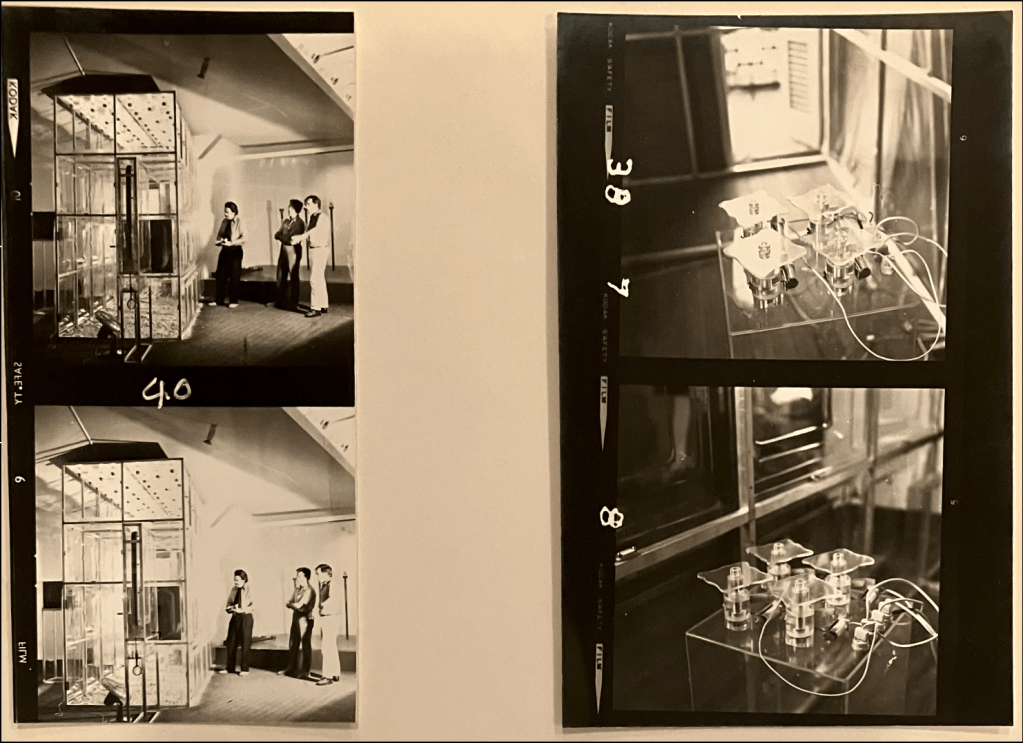
Installation of Biotrón at the Venice Biennial, 1971. Courtesy of ISLAA archive.

The following year, on occasion of his solo show at MoMA, Benedit premiered Fitotrón, a device where, through the manipulation of the variables of light, humidity and temperature, one could observe the plants’ reactions in their adaptation – or not – to these environmental changes, a proposal the work shared with Laberinto vegetal, from the following year, a black plexi box with germinating seeds at one end and a forty-watt lamp at the other. In their growth towards that light source, triggered by phototropic attraction, the plants had to navigate an itinerary that branched into two alternative paths (right/left), leading them either to death or survival.

Luis F. Benedit, Laberinto vegetal (Plant Labyrinth, 1972). Cover page of Projects and Labyrinths, Whitechapel Art Gallery, London, 1975.

The disconcerting, even revulsive effect these works provoke had to do, it seems to me, not just with having living beings in museums and galleries (instead of their usual places of residence in the human environment such as laboratories, gardens or zoos). Rather, it stems from the provocative confusion between artistic and scientific modes of encompassing and containing those lives. The opposition that gives this work its constitutive tension is not, or not only, that of nature and artifice; rather, it is the distinction between different forms of artifice and their respective effects of nature. Biotrón is perhaps where this difference between regimes of artificiality is most clearly marked: the point here is not there, as art historian Carlos Espartaco (1978: 13) claims, about “making [the bees] fluctuate between a natural environment (gardens) and an artificial one (the biotron)” because a garden is of course no less an artificial medium than an electronic meadow, only it belongs to a different regime of administration of the living. Rather than a contrast between nature and artifice, the Biotrón stages a reflection on the senses of the natural that a certain artificial order entails. Between the artificial landscape of the garden and the electronic meadow, we move from a relationship mediated by representation as imitation to one of substitution of certain relations and functions, that is, to what Tom Mitchell calls “the age of biocybernetic reproduction” (Mitchell 2003: 483-84).
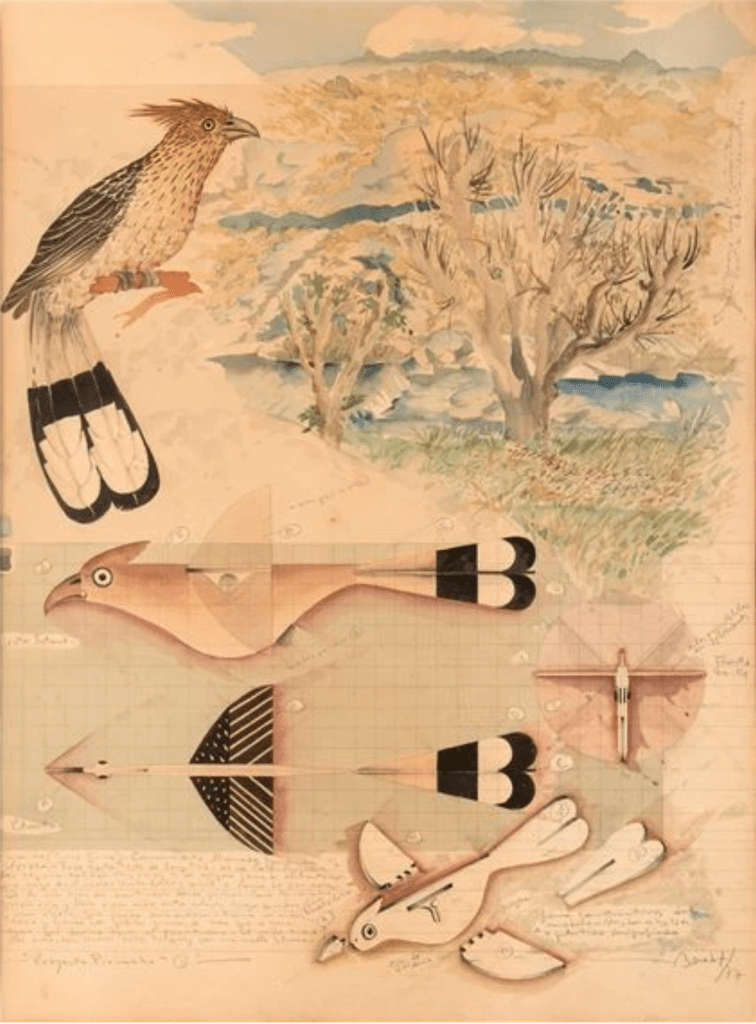
Luis F. Benedit, Proyecto Pirincho I (1977). Pencil and watercolor. Courtesy of ISLAA.

In his later work, Benedit would highlight this archaeological dimension of investigating the modern regimes of nature. After Laberinto vegetal, he effectively stopped working with living organisms to dedicate himself instead to their analytical “despiece” or “dismantling”: thus, in a series of drawings of Argentine birds, the pencil and watercolor technique of nineteenth-century naturalism is juxtaposed with the technical drawing, which “reconstructs” the flying organism through complex robotic mechanics. There is also a return to the objectual dimension as in Furnarius Rufus from 1976 –a wooden frame with an ovenbird’s nest containing an embalmed bird– and on to the collection or the museum as in Campo (1978), a kind of “Exposición Rural” or agriculture show documenting the human-animal assemblage of production mediated by biotechnology. In paintings, photographs, glass and wood containers and objects modeled in resin, this museum of Pampean biopolitics subjected to a similar kind of analytical “despiece” as the bird-robots an entire regime of human-animal life, broken down into individual elements such as a set of boleadoras, batons, stirrups, bridle and muzzle, castrating scissors and the photo of a dead pedigree bull next to the artificial insemination pills in which its frozen semen remains preserved.  In the following decade, Benedit would go even further back in his archaeological approach, turning to the pictorial production of the Pampa landscape and 'recreating' works by nineteenth-century artist León Pallière such as Un nido en la pampa, Indios del Gran Chaco and El payador (1984-85), among others. Rather than an expression of rural nostalgia, this return to “picturesque” landscape dismantles and reassembles it as one more technology for the administration of the living, an analytical “dismantling” to which Benedit subsequently also submits the Patagonian expedition of Fitz Roy and Darwin (1831-36) in his multi-installation and artist’s book From the Voyage of the Beagle (1987).

Luis F. Benedit, Tijera de castrar (Castrating scissors, 1978). Centro Cultural Recoleta, Buenos Aires.

Following the path opened by Benedit, today’s bio and ecoartists are also frequently a kind of archaeologists of the scientific forms of capturing and transforming life. By introducing an aesthetic kind of self-reflexivity into the spaces, procedures and terminologies of the “natural sciences”, bioart and ecoart also call into question the founding biopolitical division of modernity, the divide between nature and culture according to which, as Bruno Latour has argued, the essential truth of nature can be revealed to scientific reason precisely on condition of remaining absolutely external to the cultural (Latour 1993: 104-05). Hence, Benedit’s early “invasion of the laboratory”, his reenactments of the scientific procedures of the experiment, the journey and the collection, also have a (bio)political dimension, in their production of unspecific discourses and statements: these works do not become science, but neither can they be clearly assimilated to art in terms of their procedures and formal affiliations, nor, finally, can they be reduced to political messages of ecological militancy or criticisms of biotechnology. Science, art and politics come into play here in a deliberate un-specification of the artwork’s objectual form and institutional location. Perhaps we should, in fact, think of its aesthetic dimension, if we still wanted to call it that, more than anything as that vector of unspecification the material and discursive arrangement of Benedit’s works project, which is why the dimension of irony and laughter is not coindicental but actually key here: it allows us to make light of the art-science border, to the effect that the living spills out over them.

References
Benedit, Luis Fernando. Plant- en dierhabitatten . Antwerp: Internationaal Cultureel Centrum, 1976.
Espartaco, Carlos. Introducción a Benedit. Buenos Aires: Ediciones Ruth Benzacar, 1978.
Latour, Bruno. Wer Have Never Been Modern. Cambridge, MA: Harvard University Press, 1993.
Mitchell, W. J. T. “The Work of Art in the Age of Biocybernetic Reproduction,” Modernism/Modernity 10, 3 (2003): 481-500.

For a more extended discussion of Benedit’s work, see my Entranced Earth: Art, Extractivism, and the End of Landscape (2023).

Aesthetics and the Planetary Turn

From: Handbook of Latin American Environmental Aesthetics, ed. Jens Andermann, Gabriel Giorgi, and Victoria Saramago (Berlin, New York: De Gruyter, 2023), “Introduction”

(…) What the contributions to this volume are after are the multiple reconfigurations of bodies and environments within the geology of late capitalism, the moment when, as Déborah Danowski and Eduardo Viveiros de Castro put it, the “transformation of humans into a geological force, that is, into an ‘objective’ phenomenon or ‘natural’ object, is paid back with the intrusion of Gaia in the human world, giving the Earth System the menacing form of a historical subject, a political agent, a moral person.” Such an entanglement of agencies, they conclude, also entails an “inversion of the relationship between figure and ground, the ambiented becomes the ambient […] and the converse is equally the case” (Danowski and Viveiros de Castro 2017, 14).

What we call environmental aesthetics is lodged in the very moment of inversion called out by Danowski and Viveiros de Castro. Aesthetics is a concept that, at least since its re-introduction into modern critical thought by Alexander Gottlieb Baumgarten in the early eighteenth century, has been deployed as both referring to the sensory and imaginative experience of beauty—and thus also to a mode of accessing truth by way of “sensible discourse” rather than logical reasoning, in Baumgarten’s (1954, 6-10) expression—and as the “science of perception” that asks, as Kant would posit, for the general principles underwriting individual aesthetic judgements. The artwork, as it arranges the sensory in ways that strive towards perfection, thus making it accessible to “taste” as an experience of truth that is analog to yet also distinct from, critical reason, is therefore also invested with an implicit epistemic power that the discipline of aesthetics is entrusted with drawing out and making explicit. (…) Going beyond the contemplation of nature in this tradition as a vehicle for the experience of beauty or the emergence of the sublime, the “environmental” in environmental aesthetics also complicates the idealistic baggage the term aesthetics carries with it.

“Environment” is a notion first used in systematic fashion by the nineteenth-century positivist thought of Auguste Comte and Herbert Spencer, who used it to describe “the circumstances of an organism” (Bonneuil and Fressoz 2016, 173)—before, it had been deployed colloquially to refer to the surroundings of towns and cities, i.e. “the countryside.” Ernst Haeckel, in 1867, coined the notion of “ecology” highlighting the symbiotic effects among living organisms and between those and their physical conditions of existence, in response to Darwin’s notion of the struggle for survival; in early twentieth-century biology, Johann Jakob von Uexküll further developed the biosemiotic dimension of the concept as an at once perceptive and life-sustaining entanglement between organisms and their surroundings. Yet, as David Arnold (1996) has shown, environmental determinism had already informed Western thought long before it became a systematic concept in its own right, underwriting and justifying imperial expansion and the enslavement and forced migration of non-Europeans, including in Montesquieu’s and Buckle’s climatology or the biological racism of Gobineau and Malthus.[1] Nonetheless, and despite having been trained by late twentieth-century strands of thought such as poststructuralism, deconstruction, feminism and performance theory to be suspicious of all appeals to “nature” as the ultimate cause of, and normative benchmark for, human action, the surge of the planetary as encountered in Williams’s film (and in myriad forms of environmental emergency) also forces us today to double down on this critique of “nature” and rethink the agentiality of the nonhuman in different ways. For if “Gaia,” the earth system, or the “more-than-human” are no longer just objects of perception and of sensory pleasure, as Danowski and Viveiros de Castro contend, but have shown themselves to be agential, and thus also perceptive, in their own right, do we not need now to rethink the aesthetic itself as the fragile and precarious field of encounter, or even of “sympoiesis” (in Donna Haraway’s expression), between diverse existents engaged in imagining and in crafting a shared “becoming-with” (Haraway 2016, 4; 58)?

The essays assembled in this volume take stock of the lines of critical revision and of the terms and concepts that have emerged in recent years in response to this question. Two principal tasks, in fact, seem to articulate the main coordinates at work in environmental aesthetics: on the one hand, to reconfigure the sensorium that allows us to imagine, perceive, narrate and think the passage from the global to the planetary; on the other, to re-conceptualize aesthetics—in a tradition that also involves the avant-garde as well as posthuman thinking—in a way that allows us to disrupt received notions of aesthetics and make room to other arrangements of the sensible that register the agency of the non-human and the non-living. Stengers’s “intrusion of Gaia” and the now-ubiquitous notion of the Anthropocene—referring to the “major and still-growing impacts of human activity on earth and atmosphere” (Crutzen & Stoermer 2000, 17) to the point of becoming the dominant geological force of our age—as well as rival ones such as Capitalocene, Plantationocene, Gynocene or Chthulucene (all of which attempt to call into question the residual humanism of Anthropocene theory) are challenging the very foundations of modern Western aesthetics, politics and theory as premised on the ontological distinction between humanity (and hence “culture”), on the one hand, and of nonhuman “nature”, on the other (Latour 1993, 10; 32). Whichever position we choose to take with regard to its key concept, “the Anthropocene debate”—as postcolonial historian Dipesh Chakrabarty (2021, 155) contends—“thus entails a constant conceptual traffic between earth history and world history,” and to help enable such traffic by way of new concepts and paradigms at a time of advancing deterioration of the biosphere and unprecedented mass extinction at a planetary scale is the urgent task that has been set for environmental aesthetics.

Such an endeavor must of necessity be at once critical and speculative. In the former sense, it has to revisit the archive of modern arts and literature as well as that of the responses aesthetic theory has crafted from these, in order to understand their impact on, and even complicity with, the establishment and policing of the modern nature-culture boundary. In a compelling, hard-hitting book, Indian novelist and literary scholar Amitav Ghosh suggests that canonical forms of Western modernism such as the realist novel and abstract art have been of fundamental importance for establishing the primacy of human “current affairs” over their cataclysmic, short as well as long-term, entanglements with cosmic forces. The exceptional, the wondrous, “the unheard-of and the unlikely [that] fiction delighted in” prior to the emergence of realism, he suggests, have been banished in modernity to the B-genres of sci-fi and fantasy, with abstraction upping the stakes even further in eliminating reference altogether and placing “human consciousness, agency and identity […] at the center of every kind of aesthetic enterprise” (Ghosh 2016, 16; 120). Yet ecocritical approaches, particularly in the realm of literature, have also sought to re-appraise the areas and forms of dissidence that have always accompanied these hegemonic frameworks, attempting to track—in Richard Kerridge’s early description of the field—“environmental ideas and representations [and] to evaluate texts and ideas in terms of their coherence and usefulness as responses to environmental crisis” (Kerridge 1998, 5).

However, in addition to the important and necessary project of re-assessing the androcentric founding premises of modern aesthetics, and thus also of the histories of literature, art and film that underwrite the critical frameworks of our academic disciplines, environmental aesthetics as the two-way traffic between artistic production and the critical thought that draws out its interfaces with wider, socio-cultural as well as earth-systemic developments, is also in the business of imagining things differently—of mobilizing the powers of speculation to imagine but also create other ways of inhabiting the planet. The arts, as environmental humanities scholar Carolyn Merchant contends, “are an essential part of creating the large-scale public awareness and understanding of climate change that can bring about policy change,” in challenging “the standard human/environment narrative, in which humans are both privileged over other species and separate from nature. Indeed, artists can change the way we think about the meaning of progress” (Merchant 2020, 46). An aesthetics of and in the Anthropocene, as literary critic David Farrier suggests referring to a line from Irish poet Seamus Heany, must open up and inhabit “the rift between what is going to happen and whatever we wish to happen […] In doing so, it can point us to a careful retying of the knots that bind us together, in deep time, with the fate of the Earth” (Farrier 2019, 128). Indeed, if the speculative efforts of the epistêmê aisthetikê—the “science of what is sensed and imagined,” in Baumgarten’s (1954, 86-87) definition—will now have to be re-oriented towards “reading for the planet,” in energy humanities scholar Jennifer Wenzel’s (2020, 1) powerful expression, such “world-imagining” through and with art might also require us to expand our very notion of the artistic beyond conventional genres and expressive languages and toward the “sites of expanded creativity” that are in the business of “the experimental practice of world-making,” in art theorist T. J. Demos’s words. The environmental aesthetics, Demos suggests, concern themselves with the expanded field of “creative ecologies—practices that make new sensible materializations and connections (aesthetic, practical, jurisgenerative) between otherwise discrete realms of experience and knowledge, and that cultivate worlds to come” (Demos 2020, 18). On this note, literary scholar Florencia Garramuño has put forward the notion of “unspecificity” as a way of thinking about how contemporary aesthetic production, in novel and heterogeneous alliances with other realms of social practice that modernist aesthetics had kept separate from the domain of art as distinctive and “autonomous” from these, imagines and thus calls into being, “worlds-in-common”: unspecific aesthetics, for her, is the elaboration of “a language of commonalitythat encourages the invention of diverse modes of disbelonging” as the shared condition of existents in thrall to planetary crisis (Garramuño 2015, 26). Anthropologists Marisol de la Cadena and Mario Blaser have suggested the notion of “the uncommons” to account for this paradoxical togetherness of diverse agents brought about by their shared exposure to climate breakdown and mass extinction, an allyship that necessarily relies on the creative faculty of humans and nonhumans alike to be willed into being. The uncommons, then, is “the heterogeneous grounds where negotiations take place toward a commons that would be a continuous achievement, an event whose vocation is not to be final because it remembers that the uncommons is its constant starting point” (Blaser and De la Cadena 2017, 19). In different ways, these voices resonate and dialogue with a persistent theme in the twentieth-century Latin American intellectual tradition.


[1] See also Bonneuil and Fressoz’s chapter on the “Polemocene” for a more nuanced history of proto-ecological ideas in the West beyond biological and climate determinism (Bonneuil and Fressoz 2016, 253 ff).

For more details on the Handbook, click here.

To visit the Table of Contents, click here.

To buy or access through a library, click here.